

 Kevin Johnson
Google is a global tech company and the world’s largest search engine provider. Its offerings include online advertising, cloud and quantum computing, computer software, e-commerce, consumer electronics, AI-based solutions, and wearable tech. Google’s marketing strategy drives sustainable growth and strengthens the brand’s market dominance. In 2024, Google generated $350.02 billion in annual revenue. Its profit was $100.1 billion. Advertising is Google’s top revenue generator. This business segment generated $264.59 billion in 2024. But how does Google implement its marketing strategy? [1]
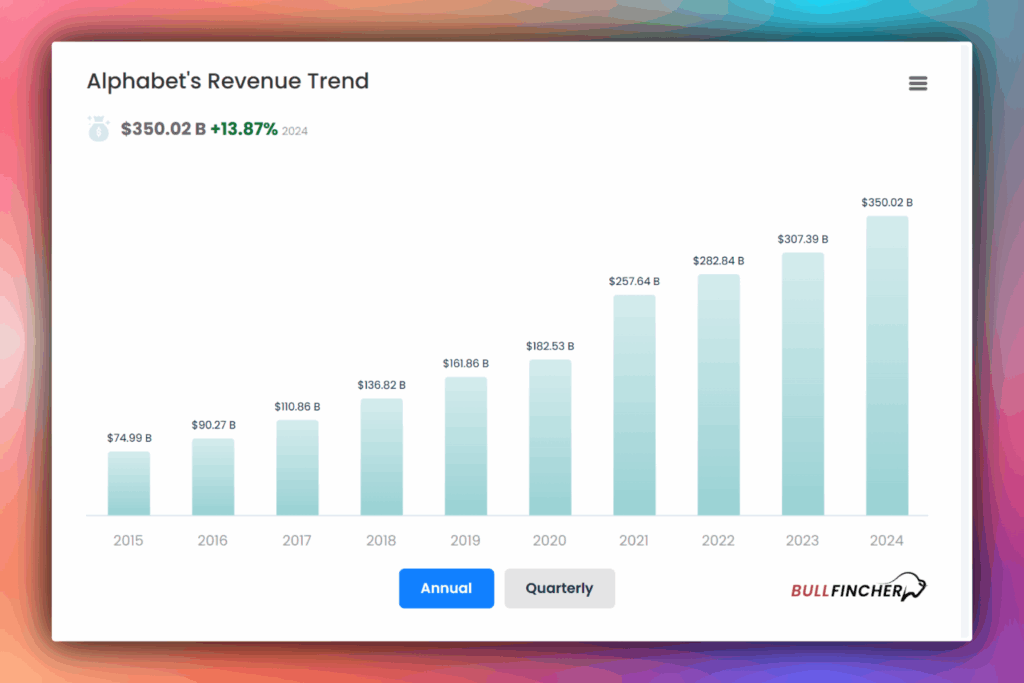
Image Source: Bullfincher.io
To understand Google’s secret to success, here is a comprehensive analysis of its marketing strategy:
Google’s Target Market Overview
Google’s target market encompasses the entire tech sector, from hardware to software and services. It caters to consumers globally across demographics, psychographics, and behavioral groups. The tech giant leverages its STP model to segment its broad target market. This strategy ensures the company delivers innovative products and services to global web users and businesses. For example, marketers and advertisers can leverage Google’s search engine and Gmail to help their companies reach the target audience. In Sep 2025, Google launched new AI-driven advertising tools. Advertisers can turn on AI-driven search ads through AI Max. This feature promotes products in AI search summaries rather than responding to specific search terms, ensuring brands appear in complex, multi-intent searches. [2]
Google’s products appeal to tech-savvy consumers. The company aims to provide services to internet users worldwide. It has led the online search market worldwide for over two decades. According to Statista, Google holds 89.71% of the global search market share across devices. Bing is Google’s closest competitor with 4.04%, followed by Yandex at 2.62%. Although Google dominates the global search market, it faces stiff competition from Baidu in China, Yandex in Russia, and Naver in South Korea. Baidu holds over 60% of the Chinese search market, making it one of the country’s top internet companies. [3]
Google’s target market includes businesses seeking innovative tech solutions. Companies leverage Google’s products to boost productivity and collaboration, expand their reach, and enhance their tech offerings. In Oct 2025, AI startup Anthropic planned to secure additional computing power from Google for tens of billions of dollars. Anthropic seeks to leverage Google’s computing and AI capabilities to outperform its competitors in the chatbot niche, including OpenAI’s ChatGPT. Meta also signed a $10 billion deal with Google Cloud to power its global data infrastructure and AI workloads. [4]
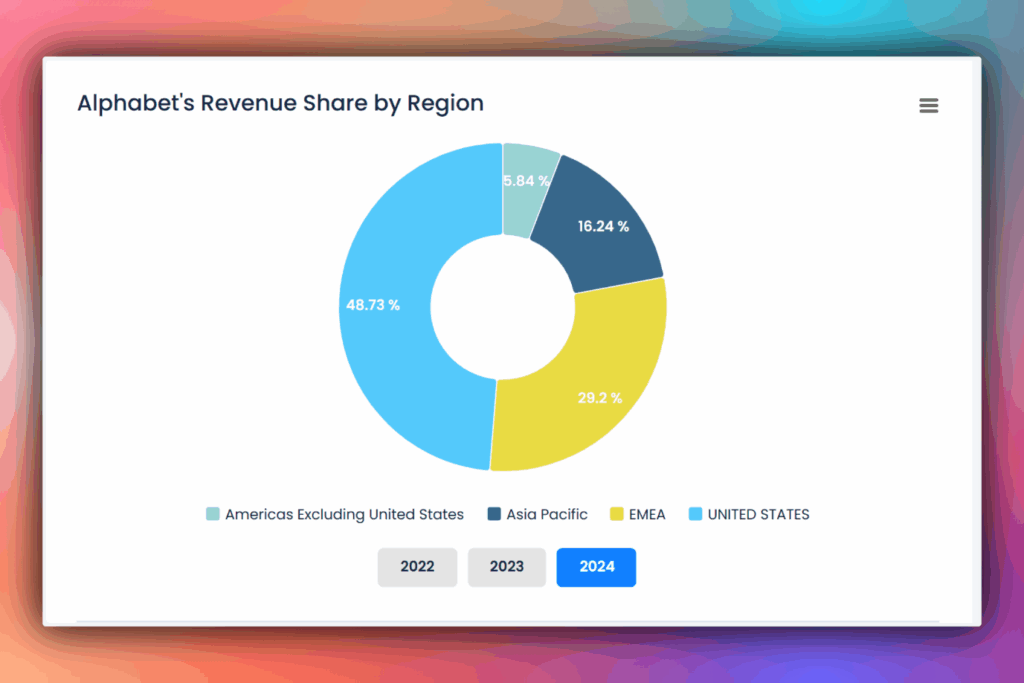
Image Source: Bullfincher.io
Google’s Positioning
Google’s positioning is defined by its mission statement: To organize the world’s information and make it universally accessible and useful. The company achieves this goal by delivering innovative technologies, support, and educational resources. It also empowers individuals and businesses to find, use, and share information effectively. For example, consumers can access directions to specific businesses near them using Google. Companies can implement search engine optimization (SEO) to deliver marketing content to their target audience. [5]
Google is positioned as a partner for individuals and businesses seeking to succeed in the digital age. The company has established itself as a global leader in search, artificial intelligence, and cloud services. It strengthens its brand positioning by offering integrated solutions. For example, Google’s comprehensive suite of products and services seamlessly integrates search, AI, and cloud functionalities. This integrated approach enhances access to information, AI capabilities, and cloud resources. The company also prioritizes search quality, providing users with the most relevant and useful information across platforms and devices. [6]
Google’s Value Proposition
Google strives to maximize value for all users, including individuals and businesses. The brand fulfills this mission by prioritizing innovation and empowerment and implementing a user-first approach in product development. These three elements are the founding blocks of Google’s values and brand promise. For example, Google pushes boundaries in search, AI, and cloud computing, helping individuals and businesses thrive.
Google’s main selling point is its integrated solutions. Users can access innovative products and services from one reliable provider. Bundled offerings maximize value for money and increase savings for individuals and businesses. In 2025, Google integrated its Gemini AI functionality in its Workspace suite. Enterprise and business customers can now access Gemini AI without paying a separate, add-on fee for generative AI features. This integration eliminated the previous $20-$30 per month for Gemini subscriptions. [7]
Google’s innovative products and services strengthen its value proposition. Leading global brands rely on Google Cloud Platform (GCP) to drive business innovation, scalability, and transformation. GCP’s robust infrastructure, advanced AI capabilities, and world-class data analytics help companies modernize and maintain a competitive edge. For example, Uber leverages GCP’s scalable infrastructure and edge computing to support its global ride-sharing operations and real-time route optimization.
Other components of Google’s value proposition include security and open source flexibility. It offers solutions like Kubernetes and Anthos that enable seamless hybrid and multi-cloud environments. For example, Target utilizes Google Cloud for data analytics, supply chain forecasting, and AI-driven product recommendations, enhancing in-store and online experiences. Samsung integrates Google Cloud AI into smart home devices, showcasing the real-world application of cloud AI. [8]
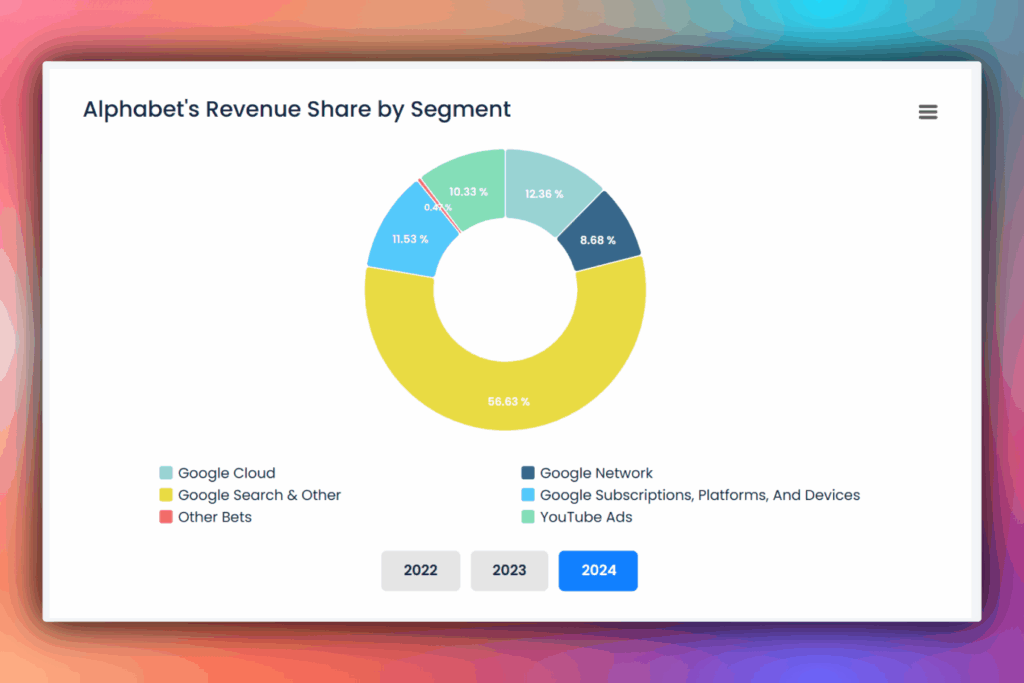
Image Source: Bullfincher.io
Google’s Marketing Mix (4Ps)
Google’s marketing mix (4Ps) reflects its strategy and priorities to strengthen its tech leadership. The 4Ps are product, price, place, and promotion. Each contributes to the brand’s overall marketing strategy. Here is an in-depth analysis of Google’s 4Ps:
Google’s Product
Google products and services include Google Search, Google Maps and Earth, Workspace, Google Play Store, Gmail, Google Meet, Google Chat, Duo, and Google TV. Google Docs, Sheets, Slides, and Drive are part of the Google Workspace suite. Its hardware business offers Pixel phones, Pixel Buds, Nest devices, and Fitbit wearables. The company ensures branding consistency by using its iconic brand colors (blue, red, yellow, and green) across its offerings. This approach strengthens Google’s marketing strategy. In May 2025, Google introduced its new logo across iOS and Pixel. The search giant ditched its color-blocked “G” for gradients, but retained the same letterform and the bright red-yellow-green-blue color sequence. [9]
Google’s products and services span the tech, mobility, commerce, and entertainment sectors. The brand leverages its dominance of the online search market to outperform rivals and increase its advertising revenue. In 2006, Google acquired YouTube for $1.65 billion, entering the video streaming sector. YouTube faces stiff competition from Netflix, Disney+, Hulu, and Vimeo. It also competes with social media platforms, including Facebook, X, Instagram, and LinkedIn. Google has been working on Waymo since 2009 to launch self-driving cars that can reshape urban transportation. [10]
Google strengthens its marketing strategy by investing in R&D. Its research and development team creates innovative solutions that address complex challenges. In Oct 2025, Google announced that it had developed the Quantum Echoes computer algorithm. This new algorithm runs on Google’s quantum chip and generates unique data for AI applications. It is 13,000 times faster than the sophisticated classical computing algorithm on supercomputers. Google unveiled its Willow quantum chip in 2024 to overcome a crucial problem with qubits, the building blocks of quantum computing. [11]
Google markets its products and services as solutions for existing challenges. The company supports innovative computing and technology research through Google.org and the Google Academic Research Awards (GARA). In Oct 2025, GARA announced its 2025 recipients. The 2025 GARA supported 56 cutting-edge projects led by 84 researchers from 12 countries. Each GARA recipient received up to $100,000 in funding to support their work. [12]
Google’s Pricing Strategy
Pricing is a critical component of Google’s marketing strategy. The brand combines pricing models to maximize revenue without compromising accessibility for billions of users worldwide. For example, Google’s freemium model offers free services, like Gmail, Google Search, and Google Drive, to attract users. Then, it monetizes premium features via paid subscriptions. The company also uses subscription-based pricing. Google One, Workspace, and YouTube Premium users pay monthly or annual fees for additional storage, productivity tools, and ad-free experiences. The brand also leverages Pay-Per-Click (PPC), dynamic, and bundled pricing models. [13]
Google customizes its prices to address specific consumer needs. The company develops customized pricing and bundles for organizations and government agencies. In Apr 2025, the US General Services Administration announced a new strategic partnership with Google. The brand agreed to lower the prices of its products and services for the federal government. It will offer Workspace to federal agencies at 71% off compared to the current Multiple Award Schedules Program (MAS IT) pricing. This deal also helps market Google products to US federal employees. [14]
Google’s Place
Google sells products and services through offline and online channels. The brand generates most of its revenue from advertising through its Google Ads and AdSense programs. Its algorithm provides relevant search results for queries and related pages from Google Ads advertisers. Then, Google generates fees from advertisers when users engage with their ads. Advertisers pay Google to “suggest” their pages to users and attempt to outbid rivals for the top spot on the search result list. Google also generates revenue from paid subscriptions for premium services, such as Google One and YouTube Premium. [15]
Google relies on sales partners and service providers to distribute its products. These entities specialize in solutions offered by Google and other tech companies. In Apr 2025, Google announced its 2025 Google Cloud Partner of the Year winners. The distinguished partners demonstrated dedication, innovation, and collaboration in delivering impactful solutions that drive success for GCP customers. [16]
Google’s sales partners specialize in technology, industry-specific solutions, AI, business applications, data and analytics, databases, Google Workspace, infrastructure modernization, public sector, security, talent development, and social impact. The company provides training, support, and resources to help its partners empower their clients and stand out in the sector. In Feb 2022, Google launched its Premier Partner tier. This tier is reserved for the top 3% of participating companies each calendar year. [17]
Image credit: Shutter Speed
Google’s Promotion
Google leverages company-owned platforms and partner channels to promote its products and services. The brand offered deals and discounts on Google Pixel 10, 9, and 8 in 2025 to help buyers save hundreds of dollars. For example, Google sold the Pixel 10 series for $799 in 2025 with Google AI (worth $239) free for a year. If a customer purchases a Google Pixel 10 from Verizon and trades in their old phone, they can get the phone for free. Consumers can access deals and discounts at Google Store, Best Buy, Xfinity, Spectrum, Mint Mobile, AT&T, and T-Mobile. [18]
Google’s Promotional Strategy
Google’s promotional strategy includes special offers, deals, discounts, bundled packages, and sponsorships. For example, Google signed its first-ever sponsorship with Team USA through the 2024 Paris Games. Google became the official search AI partner for Team USA and integrated its tools and consumer products to enhance NBCUniversal’s coverage in Paris. NBCU created an “Explain the Games” feature using Google’s search AI overviews. The deal helped promote Google’s offerings to athletes and sports fans globally. [19]
Google has focused on sports sponsorship as a promotional tool in recent years. The company is a partner of Formula One world champions McLaren. It has also invested in the NBA, NFL, college sports, esports, football, and the Olympics. These initiatives help Google showcase its technology, drive user engagement through search engine traffic or on the YouTube platform, and keep fans within the Google ecosystem. In 2001, Google leveraged defender Sol Campbell’s transfer from Tottenham Hotspurs to their rivals Arsenal to encourage phone owners to “Switch Like Sol.” The campaign included the Campbell Pixel ad. [20]
Google leverages emotional marketing to promote its products and services. It achieves this goal by running catchy or captivating commercials. For example, Google’s 2025 Super Bowl AI-themed commercial featured a father applying and preparing for a job interview using a Google Pixel 9. The “Dream Job” Super Bowl advertising campaign showed the device’s AI capabilities and how the Gemini Live chatbot provides helpful AI assistance. The ad also features the father taking care of his daughter from a crying toddler until he drops her off at college, tapping into consumers’ emotions. [21]
Google’s Customer Acquisition & Retention
Google combines traditional and tech-driven strategies to acquire and retain customers. For example, the company uses a freemium model to attract new users. It offers Google Search, Docs, Sheets, Slides, and Drive, with 15 GB storage for free. Consumers can access YouTube for free, with the option to pay a subscription fee for the premium. These offerings attract users to the Google ecosystem. They also strengthen Google’s value proposition. [22]
Google acquires and retains customers by hosting industry-specific events. These forums help consumers understand how Google’s products and services can address their challenges. In Jul 2025, the company unveiled the latest updates across Google Ads and Commerce platforms at Google Marketing Live 2025. The event attracted advertisers, developers, and business leaders seeking to leverage Google’s solutions to drive growth. [23]
Google runs innovative ads and marketing campaigns to reach its target audience. The brand achieves this goal by leveraging its online platforms and external channels. For example, Google produced its two-minute “Dream Job” ad for Super Bowl 59. The ad showcased Gemini’s real-world application by focusing on its AI capabilities and an emotional tale of a father’s relationship with his daughter. [24]
A 2017 Semrush data report revealed that Google uses its platform to promote its products. The company gives top ad space to its brands to acquire and retain customers. According to Semrush, the top two ads in 43% of searches for hardware items were for Google products. A Google product appeared in the number one advertising slot 91% of the time. Antitrust agencies penalized Google for manipulating its algorithm to direct users to its websites and products. For example, the EU imposed a $2.8 billion fine on Google for its malpractices. [25]
Google’s Marketing Goals (KPIs)
Google’s marketing goals include attracting and retaining users, increasing subscribers, and growing its market share and revenue. The brand applies key performance indicators (KPIs) to measure progress. These KPIs visualize the effectiveness of Google’s marketing strategy. In 2024, Google’s sales and marketing spending were $27.8 billion, down from $27.91 billion in 2023. The company invested 9% of its annual revenue in sales and marketing campaigns in 2022. [26]
Google implements marketing campaigns to strengthen its search market dominance and boost revenue. It is the world’s largest search engine provider. In 2024, Google’s annual revenue increased by 14% to $348.16 billion. Google Search’s global desktop market share was 78.8% as of Jan 2025. [27]
Google analyzes its brand awareness to determine the effectiveness of its marketing efforts. According to a 2024 Statista survey, 80% of smartphone owners in the US are familiar with the Google Pixel. The brand has a 24% popularity score. 31% of the respondents recognized Google as a smartphone provider in the media, social media, or advertising. However, only 9% of US smartphone owners use the Google Pixel. [28]
References & more information
- Bianchi, T. (2025, Feb 5). Google: Global annual revenue from 2002 to 2024. Statista
- Lundstrom, K. (2025, Sep 10). Google Unveils New AI Marketing Tools Ahead of Holiday Season. ADWEEK
- Bianchi, T. (2025, Jan 29). Search engines: alternatives to Google – statistics & facts. Statista
- Reuters Staff (2025, Oct 21). Anthropic, Google in talks on cloud deal worth tens of billions, Bloomberg News reports. Reuters
- Google LLC. Our approach: How Search works. Google.com
- EM Staff (2024, Apr 1). Google Brand Strategy & Positioning. Empathy Marketing
- Kirkpatrick, K. (2025, Jan 17). Will Google’s New Pricing Model Spur Usage of Gemini Leading to AI Revenue? Futurum Group
- Felix, M. (2025, Oct 9). Top 20 Companies That Use Google Cloud Platform in 2025. Tech Data Park
- Schwarz, H. (2025, May 12). Google’s “G” logo just got prettier. Fast Company
- Brock, T. (2024, Jan 6). Who Are Google’s Main Competitors? Investopedia
- Cherney, M. (2025, Oct 22). Google says it has developed landmark quantum computing algorithm. Reuters
- Hardy, R. (2025, Oct 16). Congratulations to the 2025 Google Academic Research Award recipients. Google
- Lau, S. (2025, Jan 16). How Google Pricing Strategy Drives Revenue and Market Share. Newswire Jet
- The US General Services Administration (2025, Apr 10). GSA secures cost savings through strategic agreement with Google. GSA.gov
- Johnston, M. (2025, Jan 5). How Google Makes Money: Advertising and Cloud. Investopedia
- Ichhpurani, K. (2025, Apr 9). Presenting our 2025 Google Cloud Partners of the Year. Google
- Google LLC. Become a partner: Partnership that drives success. Google.com
- Oram, A. (2025, May 14). Best Google Pixel Deals: Save Hundreds on a New Pixel 10, 10 Pro or 10 XL or Snag a Previous Release for Next to Nothing. CNET
- Axon, R. (2024, Jul 18). Google signs first-of-its-kind Team USA sponsorship. Sports Business Journal
- ISC Staff (2025, Jan 29). Why is tech investing in sports sponsorship? Google it. iSport Connect
- Giannotto, M. (2025, Feb 9). Google’s AI Super Bowl 2025 commercial is the ad every father will love during game. USA TODAY
- IntaSend (2024, Feb 24). What Is The Freemium Revenue Model? IntaSend.com
- Bompelli, O. (2025, Jul 8). Google Marketing Live 2025: Everything Marketers Need to Know. Easy Insights
- Barnett, K. (2025, Feb 6). Google’s Heartfelt Super Bowl Ad Promos Gemini-Enabled Talk Features on Pixel. ADWEEK
- George, J. (2022, Jun 30). Is Google Promoting Its Own Brands on its Own Platform? ClickSlice
- Bianchi, T. (2025, Feb 5). Alphabet: Global marketing expenditure from 2013 to 2024. Statista
- Bianchi, T. (2025, May 5). Google: Statistics & facts. Statista
- SRD (2025, Jan 8). Google Pixel brand profile in the US. Statista
- Featured Image by Nathana Rebouças
- Mobile image by Shutter Speed
Tell us what you think? Did you find this article interesting? Share your thoughts and experiences in the comments section below.


 S.K. Gupta



 Brianna Parker



Add comment