

 Kevin Johnson
Snapchat is a social media and instant messaging app developed by Snap Inc. It was created by Evan Spiegel, Bobby Murphy, and Reggie Brown, former Stanford University students. The app displays users’ pictures and messages, known as Snaps, for a brief period. Brands can leverage the app’s “Discover” feature to show ad-supported short-form content. Users can also share “Stories” and store photos in the password-protected “My Eyes Only” section. Snapchat’s marketing strategy drives sustainable growth and success. In 2024, Snap Inc. generated $5.36 billion in annual revenue. [1]
To understand Snapchat’s secret to success, here is a comprehensive analysis of its marketing strategy:
Snapchat’s Target Market Overview
Snapchat targets young, AI-hungry, and app-happy consumers. The social platform displays users’ “Stories” for only 24 hours. This feature appeals to Gen-Z consumers seeking to showcase their social lifestyles. As of Oct 2025, men aged 18 to 24 accounted for one in five Snapchat users worldwide. Women in the 18 to 24 age group represented 16.4% of the platform’s audience. 18.3% of Snapchat users were under 18 years old. Gen-Z consumers are Snapchat’s largest target audience. [2]
Snapchat’s target audience includes content creators and brands. Its digital marketing features and advertising tools help companies and marketers target Gen-Z consumers and younger Millennials. According to Sprout Social, Snapchat reaches 90% of 13 to 24-year-olds and 75% of 13 to 34-year-olds in over 25 countries. It is one of the best platforms for brands catering to young consumers. [3]
Snapchat’s target market is global. According to Statista, Snapchat had 87.7% reach in Saudi Arabia as of Feb 2025, followed by Norway with 71.6%. India was Snapchat’s largest target market, with over 210 million users in 2025. The US was second with 105 million Snapchat users, followed by Pakistan with 39 million. In 2024, over 613 million people used Snapchat. The app has 460 million daily active users. [4]
Snapchat’s Positioning
Snapchat is positioned as a social media app. The platform seeks to refine its positioning to differentiate itself from competitors. In Feb 2024, Snapchat launched its “Less social media, More Snapchat” campaign. Although Snapchat has many features common to social media platforms like Instagram and Facebook, Snap executives are insistent on its distinctness. “We wanted to make sure that it was clear to the world who we are and how important we are to the people who are big fans of Snapchat,” said Jerico Cabaysa, director of brand management and operations at Snap. The main difference between Snapchat and other platforms is that it opens to a camera and automatically deletes messages after 24 hours. [5]
Snapchat upgrades and refines its social media app to strengthen its market positioning. The platform evolved from person-to-person photo sharing to showcasing users’ “Stories” and brands’ marketing content. In May 2025, Snapchat unveiled new ad options at NewFronts, including AI-powered budget and bidding, Sponsored Snaps, and a music promotion initiative. For example, advertisers can leverage AI-powered smart bidding to set a target cost-per-action for their marketing campaigns, achieving the best outcomes within the selected parameters. [6]
Snapchat’s Value Proposition
Snapchat’s value proposition is defined by its mission statement: “To empower people to express themselves, live in the moment, learn about the world, and have fun together.” The app simplifies how users communicate human emotions with their friends and family without pressuring them to be popular, pretty, or perfect. Snapchat’s parent company, Snap Inc., also offers a camera that supports friendships and relationships through visual communication, self-expression, and storytelling. According to Snap.com, the company aims to enhance its camera to transform how people experience the world around them. [7]
Snapchat targets content creators, advertisers, brands, and social media users. The platform has a unique value proposition for each customer segment. For example, Snapchat provides a fast communication channel for users to express themselves through photos and videos. The posts disappear within 24 hours, reducing the pressure associated with online interactions. This value proposition ensures users live in the moment and have fun with their friends and family. According to stats, Snapchat has high penetration among 13-24-year-olds. Advertisers can leverage Snapchat to reach young consumers. The app also provides creative self-serving tools for creating ads, e-commerce solutions, and APIs for integrations. Brands can use these features to target their ideal audience. [8]
Snapchat communicates its value proposition through blogs, sponsored articles, social media posts, and ads. For example, Snapchat sponsored an article on Marketing Dive in Jun 2023 to explain why CPG food and beverage brands use its app. The brand highlighted the top five benefits of choosing Snapchat over alternative social media platforms. Connecting with family and friends is the #1 reason why Snapchatters use the app. Snapchat fosters genuine relationships and reaches 90% of Gen Z consumers, enabling CPG food and beverage brands to recruit future brand loyalists.
Snapchat is ranked the happiest platform among its rivals and drives audience receptivity. According to Snapchat, Snapchatters are 34% more likely to purchase products advertised on Snapchat than other social media users. Snapchatters regularly message their friends and family about food and beverages, creating a unique marketing opportunity for brands in this niche. Other benefits of using Snapchat marketing include its advertising options and AR experiences for building emotional connections. [9]
Snapchat’s Marketing Mix (4Ps)
Snapchat’s marketing mix (4Ps) reflects its strategy and priorities to strengthen its position in the social media sector. The 4Ps are product, price, place, and promotion. Each component helps drive the brand’s marketing strategy. Here is an in-depth analysis of Snapchat’s 4Ps:
Snapchat’s Product
Snapchat’s core product is its social media app. The brand strengthens its platform with new features. In Sep 2025, Snapchat launched its new “Imagine Lens” for paid subscribers. It is the company’s first open prompt image-generation AI Lens. The brand started providing its Imagine Lens to all US users for free in Oct 2025. It plans to expand this free offering to other markets, starting with Canada, the UK, and Australia. Snapchat users access Lenses over 8 billion times daily to edit their Snaps with custom prompts or generate unique Snaps. “Until now, Snapchat’s AI Lens was only available to Lens+ and Snapchat Platinum Subscribers,” said Snap Inc. [10]
Snapchat invests in product development and iteration to deliver the user experience on its social media platform. The brand began testing a redesigned version of the platform, without the Snap Map and Stories tabs, in 2024. It consolidated the app’s navigation bar around three icons: chat, camera, and Spotlight. However, in Apr 2025, Snapchat abandoned its plans for a simplified version of its app. It is experimenting with a refined five-tab interface that keeps the app’s existing tabs and simplifies access to Spotlight. “We learned a lot from the redesign, but ultimately found that it was difficult, especially for power users,” said Snap CEO Evan Spiegel. “Our most engaged Snapchatters consistently demonstrated a preference for a five-tab layout, favoring the familiarity of tile-based content discovery and a dedicated Map tab.” [11]
Snapchat’s marketing strategy includes simplifying interactions on its platform. Snapchatters use stickers to enhance communication with their friends. In Sep 2025, the brand introduced Snapchat stickers on its new iMessage App and Snapchat Keyboard for iOS & Android. This enhancement improves chats by delivering Snap’s sticker library to users’ fingertips. The brand also launched Customoji stickers to personalize Snapchatters’ communication. This new feature enhances Snapchat’s Bitmoji stickers. Snapchatters have shared Bitmoji stickers over 210 billion times. [12]
Snapchat’s Pricing
Snapchat considers how its pricing impacts its marketing efforts and sales. The brand uses freemium and subscription-based pricing models. In Sep 2025, Snapchat introduced Memories storage plans and started charging users for storing their old photos and videos on the platform. Users with over 5GB of saved Memories can upgrade to a 100GB storage plan. The platform charges $1.99 monthly for its 100GB storage plan. Its 250GB option is included in the $3.99 cost of a Snapchat+ subscription. Users have stored old posts in Snapchat’s Memories feature for free since 2016. [13]
Snapchat generates most of its revenue from advertising. The app offers unique ad formats, including augmented reality (AR) lenses and interactive story ads. For example, advertisers can use Snap Ads to post full-screen images or vertical video ads in the Discover section or between user stories. The platform also offers Story Ads and Collection Ads for showcasing multiple products within a single advert. In Jun 2025, Snapchat ads’ price was $8.39 CPM (cost per thousand impressions). Its average cost per link click (CPLC) was $0.90. Snapchat’s ad prices fluctuate throughout the year due to supply, demand, and other variables. [14]
Snapchat’s Place
Snapchat sells its offerings through its social media app. Consumers can download Snapchat from app stores to their desktop and mobile devices free of charge. The brand leverages these online sales channels to promote its social media platform and features. As of Oct 2025, the Snapchat app had 4.6 stars out of 5 on Apple’s App Store. It was ranked #5 in the photo and video category. Snapchat offers in-app purchases, including the Snapchat+ monthly plan for $4.99, the Snapchat+ annual package for $29.99, and Snapstreak Restore for $0.99, $0.49, $1.49, or $4.99. [15]
Snapchat markets and sells its services globally. However, the brand generates most of its revenue from North America. The US accounts for around two-thirds of Snapchat’s sales. It is Snapchat’s largest market, followed by Europe and Asia. In Mar 2022, Snapchat halted advertising on its platform in Russia, Belarus, and Ukraine to curb disinformation about the Russia-Ukraine war. [16]
Snapchat leverages partner sales channels to deliver its offerings to the market. For example, the brand partnered with Later in Feb 2025 to redefine content publishing on Snapchat. The collaboration introduced creator profile discovery and automated content scheduling and posting within Later’s influencer marketing and social media management platforms through Snapchat’s APIs. Marketers can now access and search for Snapchat creators through Later. Brands can also review creators’ content across platforms, manage campaign collaborations, and streamline their Snapchat creator partnerships. [17]
Snapchat’s Promotion
Snapchat offers discounts to promote both its Snapchat+ subscriptions and advertising. The brand achieves this goal through partnerships and special programs. In Aug 2025, Snapchat offered a 50% discount on the price of the first two months of Snapchat+. It provided advanced access to new features, enhancing the user experience. These promotions increase sign-ups and boost Snapchat’s subscription packages. [18]
Snapchat’s Promotional Strategy
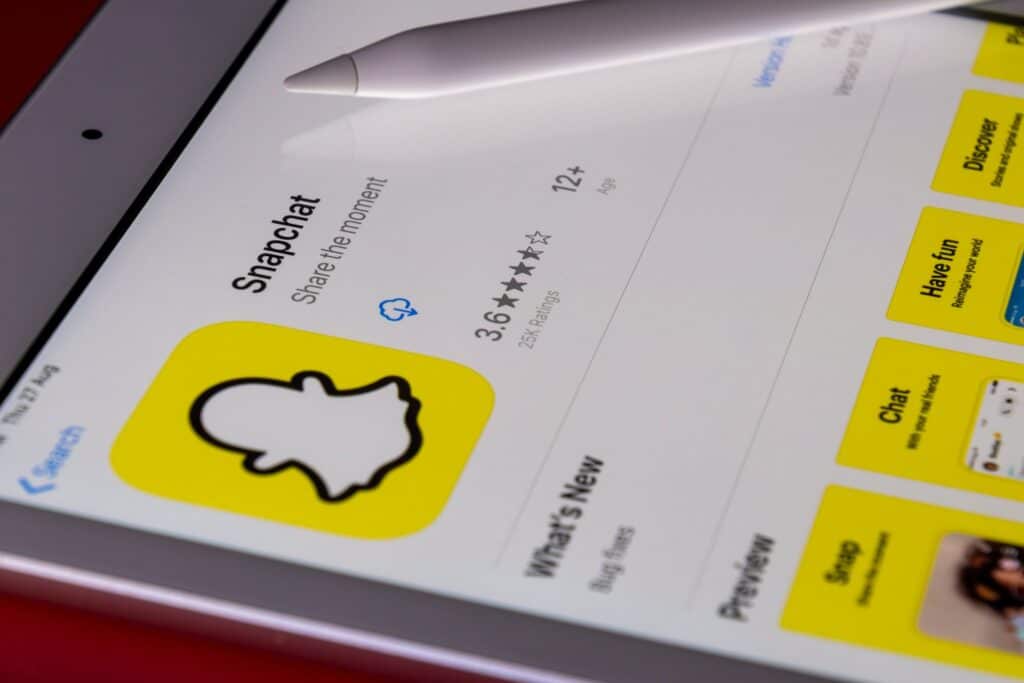
Photo by Souvik Banerjee on Unsplash
Snapchat combines traditional and tech-driven marketing strategies to promote its products. Advertisers can check for offers in the Snapchat Ads Manager or the “Incentives” section within the “Business Dashboard.” The brand also provides ad credits to new startups through third-party platforms. For example, Snap’s partner XRaise offered a Snapchat Promo Code for early-stage startups in Jun 2025. This promotional initiative provided $375 to $500 in free Snapchat ad credits. Startups can use these credits on all self-serve campaigns, including Snap Ads, Collections, AR Lenses, Geofilters, and dynamic product ads. [19]
Snapchat leverages its partnerships to promote and sell its products. For example, the brand partnered with McDonald’s USA in Jun 2025 to offer Snapchat+ subscriptions to My McDonald’s Rewards members. The McDonald’s App has over 150 million users who earn points. McDonald’s Rewards members can exchange 1500 MyMcDonald’s points to redeem a one-month Snapchat+ subscription. Snapchat+ delivers an enhanced Snap experience with pre-release and exclusive features, including customizable app icons, chat wallpapers, and AI Bitmoji pets. [20]
Snapchat implements innovative ad campaigns to promote its offerings. Its commercial ads focus on differentiating the service from competitors. In Feb 2024, Snapchat launched a new promotional campaign to present its platform as the anti-social media app. The company seeks to distance itself from the issues experienced on social apps. Snapchat’s campaign included a full-page ad in the New York Times, a 60-second commercial for the Grammys, and a 30-second Super Bowl ad. [21]
Snapchat’s promotional strategy focuses on showcasing how its app helps users, creators, and brands achieve specific goals. For example, Snapchat launched a new “Say it in a Snap” campaign in May 2025 to showcase relatable moments. The brand pitched advertisers on ad updates to help them better connect with users. [22]
Snapchat’s Customer Acquisition and Retention
Snapchat combines marketing strategies to attract new users and retain existing customers. The company attends national and global events and conferences to connect with its target audience and boost customer acquisition. In Oct 2025, Snapchat partnered with MAGNA Media Trials at Advertising Week to explore how its app benefits brands. It showcased how users leverage Sponsored Snaps to reach audiences. This insight can convince non-users to join Snapchat’s social media network. [23]
Snapchat builds strategic partnerships to drive its customer acquisition efforts. It relies on partners to sell its products and recruit new users. In Jan 2024, Snap announced its new sales partnership with Entravision, a global advertising, media, and tech company. Entravision helps brands in emerging markets engage with Snapchatters worldwide. “Snap’s partnership with Entravision will enable advertisers across APAC to access Snapchat’s highly-engaged and hard-to-reach global audience,” said Ajit Mohan, President, APAC- Snap Inc. [24]
Snapchat invests in cutting-edge technologies to attract and retain users. The brand developed its Lenses in 2015 to transform how Snapchatters interact with the world. Since its launch, 400,000 people have built over 4 million Lenses on Snapchat. Over 175 million Snapchatters play Lens Games on Snapchat monthly. The number of Snapchatters sharing Lens Games has increased by 130% since 2024. These statistics indicate the effectiveness of Snapchat’s customer acquisition and retention strategies. [25]
Snapchat’s Marketing Goals (KPIs)
Snapchat’s marketing goals include increasing subscribers and usage frequency. It analyzes key performance indicators (KPIs) to measure progress. These KPIs visualize the effectiveness of Snapchat’s marketing strategy, allowing the brand to refine and improve its campaigns. In Q1 2025, Snapchat’s daily active users (DAUs) increased by 38 million to 460 million globally. It reached a new milestone: over 900 monthly active users (MAUs). However, Snapchat lost 1 million users in North America. Snapchat DAUs in North America decreased from 100 million in Q4 2024 to 99 million in Q1 2025. [26]
Snapchat has high usage frequency. The brand achieved this goal by integrating cutting-edge solutions into its app and implementing targeted marketing campaigns. In 2024, Snapchatters created over one trillion selfie Snaps using Snap Inc.’s camera. AI and AR-powered Lenses drive creativity and storytelling on Snapchat. Snapchatters shared over one billion Snaps every month, created over 200 million Spotlight videos, and downloaded Lens Studio more than 1 million times in 2024. [27]
Snapchat assesses its financial performance to measure progress and marketing efficacy. This KPI focuses on sales, net income, profit margin, and cash flow. In 2024, Snap Inc.’s annual revenue increased by 16% year-over-year to $5.361 billion, compared to $4.606 million in 2023. Although the company isn’t profitable, it reduced its net loss from $1.322 billion in 2023 to $698 million in 2024. Its operating cash flow was $413 million in 2024, compared to $247 million in 2023. Snap’s free cash flow also increased from $35 million in 2023 to $219 million in 2024. [28]
Snapchat+ subscription contributes to Snap Inc.’s revenue. The brand implements marketing campaigns to convert more free users to paying subscribers. As of Q1 2025, Snapchat had 15 million Snapchat+ subscribers, up from five million in Q4 2023. Snapchat+ subscription revenue increased 131% in 2024. Snapchat’s Snap Star program recorded a 40% year-over-year increase in creators posting content on the app in Q4 2024. These figures indicate that Snapchat’s marketing strategy is effective. [29]
References & more information
- Dixon, S. (2025, May 21). Snap’s worldwide annual revenue from 2015 to 2024. Statista
- Dixon, S. (2025, Oct 23). Snapchat: Distribution of global audiences in 2025 by age and gender. Statista
- Hedley, R. (2025, Jul 23). How to use Snapchat for business in 2025. Sprout Social
- Dixon, S. (2025, May 23). Snapchat: Statistics & facts. Statista
- Needelman, J. (2024, May 14). Behind Snapchat’s campaign to position itself as a post-social media app. Marketing Brew
- Hutchinson, A. (2025, May 7). Snapchat Announces AI-Powered Ad Updates and Expanded Sponsored Snaps. Social Media Today
- Snap Inc. About Snap: Our Mission. Snap.com
- Sridharan, M. (2023, Apr 12). Snapchat Business Model. Think Insights
- Snapchat (2023, Jun 26). 5 reasons CPG food and beverage brands are choosing Snapchat. Marketing Dive
- Perez, S. (2025, Oct 22). Snapchat makes its first open prompt AI Lens available for free in the US. TechCrunch
- Malik, A. (2025, Apr 29). Snapchat abandons plans for a simplified version of its app. TechCrunch
- Snap Inc. (2025, Sep 25). Say it with a Sticker, Anywhere. Snap.com
- BBC (2025, Oct 1). Snapchat starts charging for storing old posts. Capital FM
- Carioli, C. (2025, Jan 2). How much do Snapchat ads cost in 2025? Gupta Media
- Snap Inc. (2025, Oct 26). Snapchat: Share the moment! Apple.com
- Johnston, M. (2024, Dec 5). How Snapchat Makes Money. Investopedia
- Snap Inc. (2025, Feb 27). Later Announces Partnership with Snap Inc., Delivering the Industry’s Most Comprehensive Integration for Social and Influencer Marketing. Yahoo
- Hutchinson, A. (2025, Aug 3). Meta, X, and Snapchat Offer Discounts on Paid Subscription Packages for Summer. Social Media Today
- XRaise (2025, Jun 6). Snapchat Promo Code for Startups: Save Up To $500 on Ad Spend. XRaise.ai
- Snap Inc. (2025, Jun 10). Unlock Snapchat+ with MyMcDonald’s Rewards Points. Snap.com
- Hutchinson, A. (2024, Feb 2). Snapchat’s New Ad Campaign Pitches It as “Antidote to Social Media.” Social Media Today
- Blancaflor, S. (2025, May 7). Snapchat to Snap Up Brands with Ad Campaign and Music Series. ADWEEK
- Snap Inc. (2025, Oct 6). Snapchat at Advertising Week New York 2025 – Enter the Chat. Snap.com
- Entravision (2024, Jan 3). Entravision and Snap Inc. Enter Into a Strategic Partnership in APAC. Entravision.com
- Snap Inc. (2025, Oct 16). Lens Fest 2025: Building the next decade of AR together. Snap.com
- Jones, M. (2025, Apr 30). Snapchat’s Q1 growth is overshadowed by the specter of tariffs. E-Marketer
- Snap Inc. (2025, Sep 18). More Than a Trillion Selfies, Shared on Snapchat. Snap.com
- Snap Inc. (2025, Feb 4). Snap Inc. Announces Fourth Quarter and Full Year 2024 Financial Results. Snap.com
- Dixon, S. (2025, May 23). Snapchat: Statistics & facts. Statista
Tell us what you think? Did you find this article interesting? Share your thoughts and experiences in the comments section below.


 S.K. Gupta
 Brianna Parker





Add comment