
 Kevin Johnson
Pepsi is one of the world’s leading beverage brands. Its portfolio includes carbonated and non-carbonated soft drinks, coffee, teas, sports and energy drinks, bottled water, and juices. The brand caters to consumers seeking refreshing fizzy beverages. In Feb 2025, Pepsi Zero introduced new “Strawberries ‘N’ Cream” and “Cream Soda” flavors. These bold flavors redefine sugar-free indulgence with unique and nostalgic taste experiences. [1]
Pepsi implements innovative marketing campaigns to outperform competitors and increase its market share. Its iconic 1990s Super Bowl ads are still popular among American football fans. In 2025, the brand revived its 50-year-old Pepsi Challenge marketing campaign. It hosted blind taste tests of Pepsi Zero Sugar and Coke Zero Sugar during the Super Bowl weekend. Pepsi outperforms Coke during these events. These blind taste tests also increase consumer engagement, brand awareness, and customer loyalty. [2]
Pepsi has operated in the soft drink sector for over 130 years. The brand retained its relevance by expanding and refining its product lines to satisfy the evolving needs and preferences of its customers. Its labels include Pepsi Original, Diet Pepsi, Pepsi Max, Pepsi Zero Sugar, and Pepsi Next. Each has unique flavors and ingredients. In Apr 2024, Pepsi launched its Sting Blue Current beverage. This limited-edition carbonated energy drink targeted consumers in India. [3]
Pepsi has been Coke’s arch-rival since the 1920s. It is the world’s second-most popular soft drink after Coke. In 2023, Pepsi controlled a 27% share of the US carbonated beverage market. Coke dominated the US market with a 69% share, according to AdAge. Coca-Cola is Coke’s parent company. But who owns Pepsi? [4]
Checkout: Bullfincher.io
Who is Pepsi’s Owner?
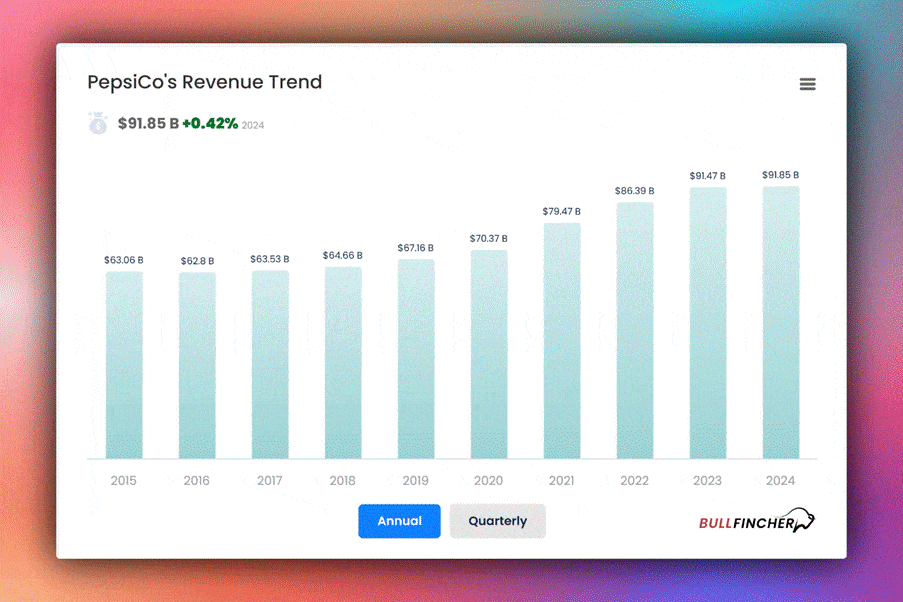
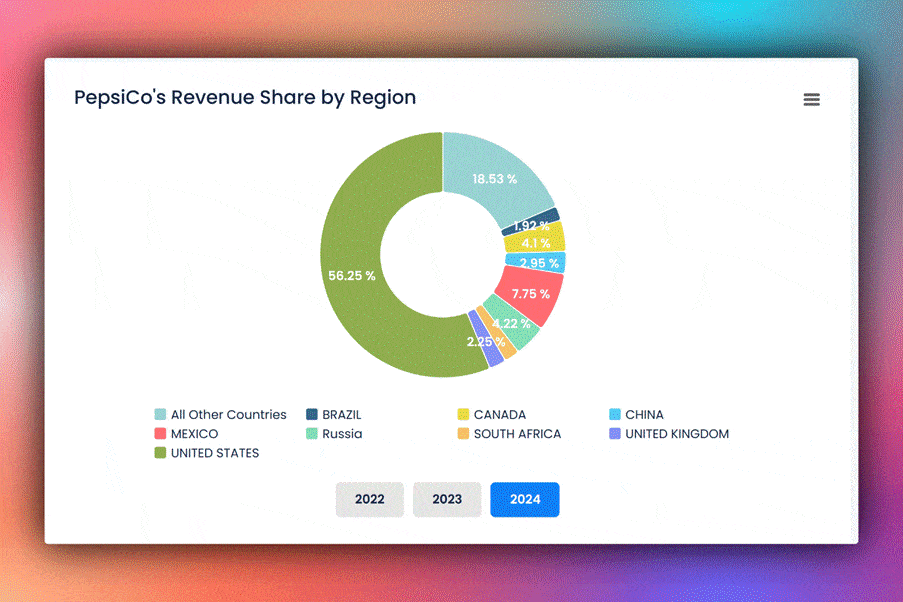
Pepsi is owned, produced, and distributed by PepsiCo, Inc., an American food and beverage company based in Purchase, Harrison, New York. The parent company was formed after Pepsi-Cola merged with Frito-Lay in 1965. Ramon Laguarta is the CEO and Chairman of PepsiCo. In 2024, PepsiCo generated $91.9 billion in annual revenue, with a profit of $9.58 billion. Pepsi is PepsiCo’s top income generator. [5]
PepsiCo operates across the food and beverage sectors. CEO Ramon Laguarta oversees the PepsiCo international enterprise. However, each regional and national PepsiCo division has a top leadership team, including CEO, COO, and CFO. For example, Ram Krishnan is the PepsiCo CEO of Beverages North America. Krishnan creates color-coded pie charts to help him lead $27 billion beverage division. He oversees Pepsi, Mountain Dew, and Gatorade in the US, Canada, and Mexico.
Krishnan’s systematic approach guided him through an 18-year career at PepsiCo, ensuring he balances professional demands and personal growth. The regional CEO has led various PepsiCo units, including the Asia Pacific region, and transformed PepsiCo’s operations in China. “The growth had moved from east and south China to central and west. We had to redo the go-to-market strategy, manufacturing footprint, and talent approach,” said Krishnan. In 2023, PepsiCo’s North America Beverages division generated $27 billion in annual revenue under Krishnan’s leadership. [6]
PepsiCo implements strategies to help Pepsi cut costs, boost efficiency, and improve its profit margins. It assesses market forces to determine the most appropriate countermeasures and steps. For example, Pepsi experienced sales declines and slowdowns in its US market in 2025. Its parent company responded by consolidating operations to boost production efficiency and reduce excess costs. In Jul 2025, Pepsi announced plans to stop production, maintenance, and transport operations at its Detroit manufacturing plant. These changes impacted 83 employees. The company closed four bottling plants in 2024 and two manufacturing facilities for its North American food business in 2025. [7]
Pepsi is PepsiCo’s flagship soft drink. PepsiCo owns 23 billion-dollar brands, including Pepsi, Mountain Dew, Lay’s, Gatorade, Tropicana, Doritos, Quaker, Walkers, Baken-ets, Cheetos Popcorn, and Tostitos. The parent company expands its portfolio to meet consumer demand. In Mar 2025, PepsiCo acquired Poppi for $1.95 billion to offer healthy prebiotic sodas. “More than ever, consumers are looking for great-tasting options that fit their lifestyles and respond to their growing interest in health and wellness,” said Ramon Laguarta, Chairman and CEO of PepsiCo, “Poppi is a great complement to our portfolio transformation efforts to meet these needs.” [8]
PepsiCo has 318,000 employees and distributes Pepsi products through retailers, groceries, convenience stores, and wholesalers in 200 countries and territories. It leverages hundreds of mobile apps to serve consumers globally. In the 2020s, PepsiCo developed a customized direct-to-consumer version to connect its mobile apps with one consumer data platform. The company launched its integrated app in Mexico and Brazil in 2023 and in North America in 2024. It powers engagement and interaction with customers globally through a localized app. [9]
Pepsi relies on PepsiCo’s management, distribution network, and strategic investments to drive its growth. The parent company operates hundreds of plants globally. In 2023, PepsiCo Ireland invested €39 million to expand its Cork manufacturing facility. The plant uses the latest technologies to produce concentrate for Pepsi, Pepsi Max, Gatorade, Mountain Dew, and 7Up. Its expansion will expand PepsiCo’s innovation pipeline and help Pepsi reach its global customer base. [10]
Checkout: Bullfincher.io
Pepsi’s Ownership History
Caleb Bradham introduced Pepsi in 1893 as Brad’s Drink. The young pharmacist from New Bern, North Carolina, was the original Pepsi owner. He experimented with different soft drink concoctions and recruited patrons and friends to sample them at his drugstore. Brad’s Drink combined carbonated water, sugar, vanilla, rare oils, and cola nuts. In Aug 1898, Caleb Bradham rebranded his flagship beverage to Pepsi-Cola and unveiled its first logo.
Pepsi-Cola grabbed consumers’ attention within 3 years. The demand encouraged Bradham to develop his soft drink into a full-fledged business. Bradham applied for a trademark with the US Patent Office in 1902 and founded the first Pepsi-Cola Company. He relocated Pepsi-Cola’s bottling from his drugstore to a rented warehouse and invested $5,000 to expand bottling and syrup operations. This move helped increase the company’s syrup sales from 7,968 gallons in 1903 to 19,848 gallons in 1904. By 1906, Pepsi had 15 US bottling plants. It adopted a new logo, with the slogan “The Original Pure Food Drink,” and registered its trademark in Canada and Mexico. Its syrup sales increased from 38,605 gallons in 1906 to 104,026 gallons in 1907. [11]
Pepsi’s growth slowed down in the 1910s. The company entered its first tumultuous period under Caleb Bradham’s ownership. It launched the “Drink Pepsi-Cola, it will satisfy you” campaign in 1920 to boost sales. This initiative didn’t help Pepsi recover from the slump. In 1923, the Pepsi-Cola Company declared bankruptcy and sold its assets to North Carolina-based Craven Holding Corporation for $30,000. This deal changed Pepsi’s ownership from Caleb Bradham to Craven. Roy C. Megargel, a Wall Street broker, acquired the Pepsi trademark, business, and goodwill from Craven for $35,000 and formed the Pepsi-Cola Corporation.
Pepsi’s woes continued under Roy Megargel’s ownership. The Pepsi-Cola Corp posted losses for five years. In 1928, Megargel reorganized his corporation as the National Pepsi-Cola Company. This new entity became the fourth parent company to own the Pepsi trademark. In 1931, the National Pepsi-Cola Company filed for bankruptcy and sold its trademark and assets to Loft, a candy company. Charles G. Guth, President of Loft, assumed leadership of Pepsi and founded the modern Pepsi-Cola brand. Guth acquired Megargel’s interest in the company, increasing his ownership of Pepsi to 91% by 1933. [12]
Caleb Bradham died at 66 in 1934, with his legacy resting on Guth. The company thrived under Guth’s ownership. It reformulated its Pepsi-Cola syrup formula and introduced its 12-ounce drink for five cents in 1934 to attract Depression-worn Americans. In 1936, Pepsi granted 94 new US franchises and reported $2.1 million in annual profits. The Board of Directors ousted Guth from the company in 1939 for planning to acquire a competing cola brand. Pepsi’s stock traded on the New York Stock Exchange for the first time in 1941. This move extended Pepsi-Cola’s ownership to external investors and the general public. In the 1950s, Pepsi was one of the first major American companies to appoint a woman to its board. [13]
Pepsi leveraged innovative marketing campaigns and strategic mergers and acquisitions to fuel its growth. Its iconic campaigns include the 1940 “Nickel, Nickel,” 1943 “Bigger Drink, Better Taste,” 1953 “The Light Refreshment,” 1962 “Pepsi Generation,” and 1976 “Have a Pepsi Day!” and “Puppies.” The company introduced Diet Pepsi and acquired Mountain Dew in 1964. In 1965, Pepsi-Cola and Frito-Lay merged to form PepsiCo, Inc. This merger transferred Pepsi’s ownership to PepsiCo. [14]
Pepsi thrived under PepsiCo’s ownership, becoming the single largest soft drink brand sold in American supermarkets in 1976 and #1 in sales in the home market in 1980. The parent company introduced Pepsi Free, Crystal Pepsi, and Wild Cherry Pepsi, reformulated Diet Pepsi with NutraSweet, and added Mug Root Beer to the Pepsi portfolio. These investments increased Pepsi’s competitiveness. In 2021, Pepsi’s market share in the carbonated soft drink category was 8.9%. [15]
PepsiCo invests in innovative technologies and solutions to grow Pepsi’s customer base. For example, in Jan 2023, PepsiCo expanded its SodaStream in-home and in-office sparkling water systems. Customers use the SodaStream technology to create carbonated Pepsi drinks and refill bottles at home. They can also mix Pepsi concentrates for a customized beverage. This solution increases Pepsi’s appeal among eco-conscious consumers. [16]
PepsiCo refines Pepsi’s positioning to align with the ever-evolving needs of consumers. For example, health-conscious consumers are concerned about the risks of consuming soft drinks with high sugar concentrations. PepsiCo responded to these concerns by introducing the low-sugar Diet Pepsi and Pepsi Next, with 60% less sugar than the original Pepsi. In 2024, PepsiCo planned to acquire Siete Foods for over $1 billion. The company will leverage this acquisition to offer healthier grain-free options, including tortilla chips, tortillas, hot sauces, and other Mexican-American staples. [17]
Image Source: Nagy Arnold
Pepsi’s Shareholder Structure
Pepsi is a wholly-owned PepsiCo brand specializing in soft drinks. Its ownership is defined by PepsiCo’s shareholder structure. PepsiCo is a public company trading on the NASDAQ under the PEP ticker symbol. As of Sep 2025, PepsiCo had 1,371,000,000 shares outstanding. This figure is impacted by stock splits and share buybacks. The company is #76 on CMP’s ranking. It has $205.74 billion market cap and $150.28 share price. [18]
Pepsi’s ownership is spread between institutions and the general public. PepsiCo has 4,170 institutional investors. As of Jun 2025, Vanguard Index Funds was PepsiCo’s largest institutional shareholder, with 3.14% of the company. This stake represents 4.08 million shares. Vanguard 500 Index Fund is PepsiCo’s second-largest shareholder with 2.77%, followed by Invesco QQQ Trust at 2.01%, Schwab at 1.34%, Fidelity Concord Street Trust at 1.24%, SPDR S&P 500 ETF at 1.18%, and iShares Trust at 1.16%. [19]
PepsiCo’s stock is primarily owned by institutional investors. Insiders, like the CEO, CFO, COO, and Directors, hold only 0.19% of the company. According to Yahoo Finance, PepsiCo insiders reported seven transactions worth $476,226.64 between Jun and Jul 2025. These activities included 6 equity awards and 1 tax payment. As of May 2025, Chairman and CEO Ramon Laguarta owned 469,210 shares. He is PepsiCo’s largest insider shareholder. Ramon Laguarta’s latest transaction was a sale in Mar 2025. Officer Steven Williams is the second-largest insider shareholder (122,663 shares), followed by Director Daniel Vasella at 86,665, Officer Eugene Willemsen at 55,992, General Counsel David Flavell at 42,660, Officer Marie Gallagher at 22,673, and Director Segun Agbaje at 11,701. Other PepsiCo insiders holding shares include Jennifer Bailey, Susan Diamond, and Dave Lewis. [20]
PepsiCo’s active investors influence Pepsi’s operations. They leverage activism to protect their investments in the company. In Sep 2025, Elliott Investment Management invested $4 billion in Pepsi, becoming PepsiCo’s top five active investors excluding index funds. The Paul Singer-founded Elliott believes Pepsi should evaluate the potential refranchising of its bottling network and streamline its portfolio by divesting underperforming assets.
“With the right mindset and an appropriately ambitious turnaround plan, PepsiCo today represents a rare chance to revitalize a leading global enterprise and unlock significant shareholder value,” said Elliott Investment Management. As of Sep 2025, Elliott managed over $70 billion in assets. Its long history of activism has yielded strong returns for investors. Elliott aims to help PepsiCo sharpen its focus, drive innovation, and enhance efficiency and value. PepsiCo’s share price increased by 5% after Elliot invested in the company. [21]
PepsiCo rewards shareholders through dividends and optimizes its portfolio with share offers and buybacks. The company expects to return a value worth $8.6 billion in 2025. This figure includes $7.6 billion in dividends. According to Zacks Equity Research, PepsiCo shares lost 5.3% in three months compared with the industry’s 5.6% decline as of Jul 2025. Pepsi plans to repurchase shares worth $1 billion in 2025. [22]
References & more information
- Norsten, G. (2025, Feb 3). Pepsi Zero Introduces New Flavors for Next-Gen Cola Lovers. Trend Hunter
- Meyers, A. (2025, Feb 5). Inside PepsiCo’s Super Bowl marketing playbook. Marketing Brew
- FB Insights (2025, May 23). Asia Pacific Beverages Market Size, Share, and Growth: 2025. Fortune Business Insights
- Maverick, J. (2025, Mar 18). Coke vs. Pepsi: Who Rules the Beverage Industry? Investopedia
- Ridder, M. (2025, Apr 8). PepsiCo’s net revenue worldwide from 2014 to 2024 by division. Statista
- Marioni, M. (2024, Sep 27). PepsiCo North America CEO makes a color-coded pie chart of his waking hours to help him lead $27 billion beverage division. Yahoo Finance
- Tronco, F. (2025, Jul 25). Pepsi issues stern message to employees after mass closures. The Street
- Chen, C. (2025, Apr 1). Pepsi hopes to bubble up interest in health-conscious consumers with the Poppi acquisition. The Ticker
- Koetsier, J. (2023, Dec 6). PepsiCo: New Strategy for Mobile, Customer Data, and Digital Transformation. Forbes
- Invest in Ireland (2023). PepsiCo Announces €39m Expansion of its Manufacturing Facility in Little Island. IDA Ireland
- PB Staff (2021, Jun 18). The History of Pepsi-Cola. Pepsi Brattleboro
- Lucas, A. (2025, Aug 21). PepsiCo, Inc.: History, Products, & Facts. Britannica
- PepsiCo, Inc. A legacy of leadership: Honoring past and present pioneers. PepsiCo.com
- HO Staff (2024, Jan 4). The Pepsi Generation: The Ad Campaign. History Oasis
- Ridder, M. (2024, May 16). PepsiCo: Statistics & facts. Statista
- Mohan, A. (2023, Jan 24). PepsiCo doubles down on scaling up Reusable Packaging. Pack World
- Market Lens (2024, Oct 1). PepsiCo’s $1 Billion Bet on Healthier Snacking: The Strategic Acquisition of Siete Foods. Kavout
- CMP (2025, Sep 3). PepsiCo (PEP): Shares outstanding. Companies’ Market Cap
- Yahoo Finance (2025, Jun 30). PepsiCo, Inc. (PEP): Top Institutional Holders. Yahoo.com
- Yahoo Finance (2025, May 30). PepsiCo, Inc. (PEP): Insider Roster. Yahoo.com
- Li, Y. (2025, Sep 2). Pepsi shares jump as activist Elliot takes a $4 billion stake. CNBC
- Zacks Equity Research (2025, Jul 17). PepsiCo Beats Q2 Earnings & Revenue Estimates, Improves 2025 EPS View. Yahoo Finance
- Featured Image by NIKHIL
- Can Image by Nagy Arnold
Tell us what you think? Did you find this article interesting?
Share your thoughts and experiences in the comments section below.







Add comment