
 Kevin Johnson
Apple is a consumer electronics company founded in 1976 and based in Cupertino, California. It specializes in smartphones, PCs, tablets, and wearables. The company also offers music and TV streaming services, accessories, cloud storage, digital money services, and a mobile browser. In fiscal year 2024, Apple generated $391 billion in annual revenue. This figure translates to over $1 billion in sales daily. Apple’s profit was $94 billion. [1]
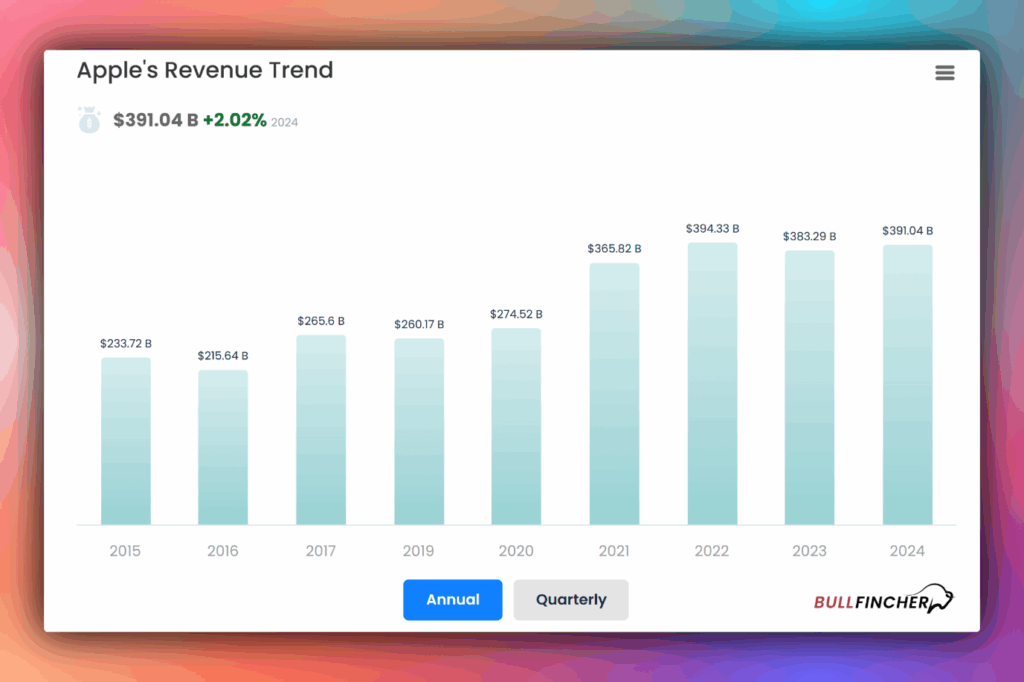
Image Source: Bullfincher.io
Apple is the world’s most valuable brand and the largest technology company by revenue. It was the fastest retailer globally to surpass $1 billion in annual sales. The company operates 512 Apple retail stores in 23 countries worldwide, with a strong market presence in the US. In Mar 2025, the UK had 40 Apple stores. Consumers can purchase Apple products through partner retailers and online platforms. [2]
Apple has dominated the consumer electronics sector for decades by refreshing its products. The company upgrades its PCs, tablet computers, and smartphones to meet the evolving needs and preferences of consumers. In 2024, Apple released around 30 new products, including the iPhone 16, iPad Pro M4, MagSafe charger, MacBook Pro M4, and Magic Keyboard. The iPhone 16 has a new processor, the A18, a RAM boost, and Apple Intelligence. iPhone 16 Pro Max owners can charge their phones with the MagSafe Charger to 50% in 34 minutes and 100% in 2 hours and 23 minutes. New features help Apple retain its loyal customer base and boost sales. [3]
Apple stands out thanks to its proprietary mobile operating system (OS). Its electronics run on iOS while competitors use Google’s Android OS. In Q1 2025, Android was the leading mobile OS worldwide with a 71.88% market share, followed by Apple’s iOS with 27.65% share. Apple’s iOS had 57.68% of the US market share compared to Android’s 42.06%. It outperformed Android in Japan (68.86%), Canada (60.31%), Australia (59.63%), and the UK (52.29%). But who owns Apple? [4]
Who is Apple’s Owner?
Apple Inc. is a public company listed on the NYSE and owned by its shareholders. It trades under the AAPL symbol. Anyone can acquire Apple shares to own a stake in the tech company. Apple’s top management oversees operations to deliver shareholder value. In Mar 2025, Tim Cook was Apple’s Chief Executive Officer (CEO). Cook joined the company in 1998 and rose through the ranks, becoming Chief Operating Officer (COO). He replaced Steve Jobs as the CEO. Apple’s top management includes Chairman Arthur Levinson, COO Jeff Williams, CFO Luca Maestri, General Counsel Katherine Adams, VP of Services Eddy Cue, VP of Software Engineering Craig Federighi, VP of Hardware Technologies Johny Srouji, VP of Worldwide Marketing Greg Joswiak, VP of Operations Sabih Khan, VP of Machine Learning and AI Strategy John Giannandrea, VP of Retail Deirdre O’Brien, and VP of Hardware Engineering John Ternus. [5]
Apple Inc. operates across the hardware, software, and services niches. It’s hardware segment includes iPhone, Mac, iPad, AirPods, and Apple Watch. In 2024, Apple generated $201.18 billion from the iPhone, $37 billion from wearables, home, and accessories, $30 billion from the Mac, and $26.69 billion from the iPad. Apple’s services segment includes Apple Music, Apple TV+, cloud storage, and in-store repairs. This segment generated $96.2 billion in 2024. [6]
Apple owns iconic brands, including the iPhone, MacBook, Apple Music, iPad, Apple Watch, AirPods, and iMac. Each brand targets tech-savvy consumers seeking innovative products. The iPhone is one of the world’s best-selling smartphone brands. It was Apple’s top revenue generator in 2024 at 51%, followed by services at 25%, wearables and accessories at 9%, Mac at 8%, and iPad at 7%. In 2025, the US had 155 million iPhone users. Over 1.38 billion people use iPhones. This figure has increased by 1.05 billion since 2015. [7]
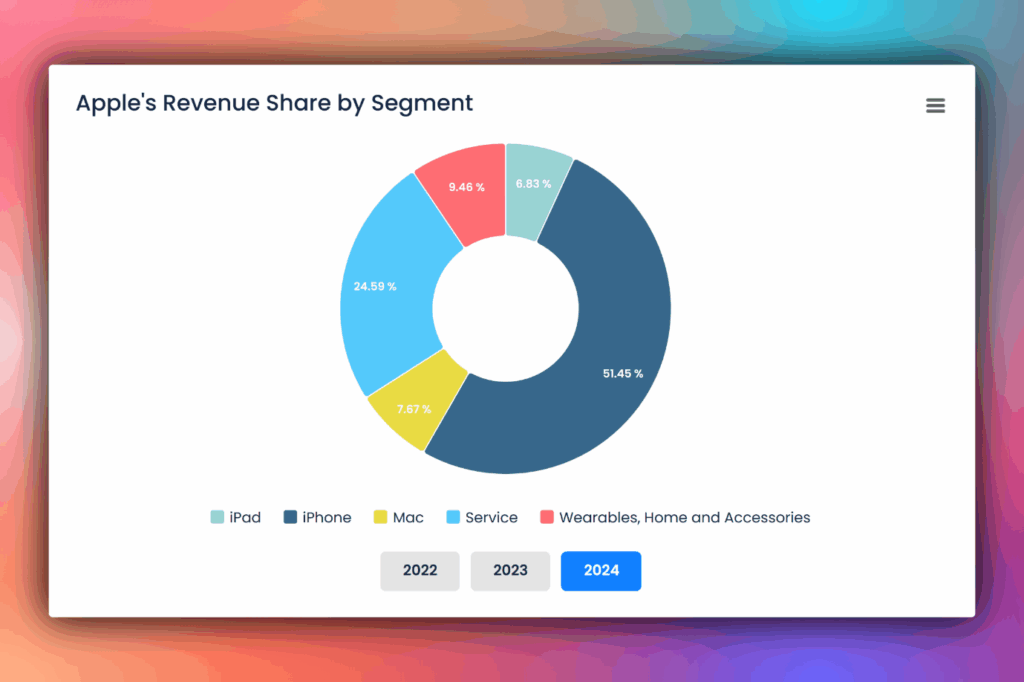
Image Source: Bullfincher.io
Apple designs its products in-house in the US. Then, it outsources manufacturing to partners in countries with low production costs. Although this strategy boosts Apple’s profit margin, it exposes the tech giant to geopolitical challenges. In May 2025, Donald Trump threatened to impose a 25% tariff on iPhones manufactured outside the US. This announcement wiped around $70 billion off Apple’s shares, reducing its valuation to under $3 trillion. [8]
Apple reassesses and optimizes its business strategies to accelerate growth. The company analyses its SWOTs to maximize strengths, minimize weaknesses, exploit opportunities, and mitigate threats. For example, the US-China tariff war threatened Apple’s business. The tech giant responded by announcing a new $100 billion commitment to America in Aug 2025.
Apple plans to invest $600 billion in the US and hire 20,000 people in four years. This investment will help the company manufacture more products in America. As of Aug 2025, Apple partnered with thousands of suppliers across 50 states, supporting over 450,000 jobs. It exports two-thirds of the parts and components manufactured in the US to customers worldwide. “Today, we’re proud to increase our investments across the US to $600 billion over four years and launch our new American Manufacturing Program,” said Tim Cook, Apple’s CEO. [9]
Apple’s Ownership History
Steve Jobs, Steve Wozniak, and Ronald Wayne founded Apple Computer Company in Apr 1976. The three inventors were Apple’s original owners. However, Apple was born from Wozniak’s aspiration and lifelong dream of building a personal computer. He was inspired by the 1975 Altair 8800, the first commercial microcomputer. The 26-year-old engineering intern at Hewlett-Packard developed a simple gaming motherboard. This product was Steve Wozniak’s first personal computer.
Wozniak presented his motherboard design to Hewlett-Packard. However, Hewlett-Packard wasn’t interested in the product. Wozniak partnered with a former high school classmate, Steve Jobs, to create a computer company. They sold some of their possessions to finance the venture and set up their operations in the Jobs family garage. In Apr 1976, Ronald Wayne joined Wozniak and Jobs to launch Apple Computer Company. Jobs and Wozniak each held a 45% stake in the company, while Wayne owned a 10% partnership stake. [10]
Ronald Wayne was an experienced tech industry executive who helped integrate the founders’ company vision and operational pursuits. Apple attracted Intel Corporation veteran Armas Clifford Markkula as its first angel investor. In Jul 1976, the company unveiled its inaugural product, the Apple I, for $666.66. Ronald Wayne sold his 10% stake back to Jobs and Wozniak for $800. Although Apple was a startup, Markkula saw its potential. The investor provided his expertise and $250,000 in seed funding. Apple was incorporated in Jan 1977. It released the Apple II in Apr 1977 for $1,298. [11]
Wozniak introduced a disk controller, delivering an affordable floppy disk drive to the market. This product enhanced the Apple II with faster, reliable data storage. In Dec 1980, Apple went public through an IPO. It offered 4.6 million shares at $22 each. The IPO extended Apple’s ownership to external investors and the public. Apple has undergone five stock splits since its IPO: 2-for-1 in Jun 1987, 2-for-1 in Jun 2000, 2-for-1 in Feb 2005, 7-for-1 in Jun 2014, and 4-for-1 in Aug 2020. [12]
Apple introduced the Macintosh to consumers through a TV commercial during the 1984 Super Bowl XVIII. Wozniak left Apple to become a teacher in Feb 1985, and CEO Sculley ousted Jobs from the company in Sep 1985 following Mac’s poor sales performance. In 1985, Jobs founded NeXT Inc. after leaving Apple. He bought Lucasfilm’s Computer Graphics Division to create Pixar Animation Studios. In 1987, Apple introduced the Mac II and Mac SE. These products served over one million users. The company appointed Michael Spindler as CEO in 1993 to replace Sculley. It acquired Jobs’ NeXT Inc. in 1996 to leverage the NEXTSTEP operating system, the foundation of macOS.
Apple selected Gilbert Amelio to replace Spindler as CEO. Jobs sold his Apple stake for the NeXT sale but retained one share. In 1997, Apple’s board selected Jobs to succeed Amelio as CEO after the company failed to achieve profitability. Apple had a profitable fiscal year in 1998, its first since 1995. It introduced iTunes in 2001, iPod and iPod Nano in 2005, the iPhone in 2007, the iPhone 3GS in 2009, iPad in 2010, and iCloud in 2011.
Jobs resigned as Apple CEO because of ill health in Aug 2011 and died from cancer in Oct 2011. He was succeeded by Chief Operating Officer Tim Cook. Apple released new versions of previous products under Cook’s tenure, including the iPhone 4S, the iPad Mini, and the iPad Pro. In 2014, Apple acquired Beats by Dre for $3 billion. The company launched Apple Pay, the Apple Watch in 2015, AirPods in 2016, and HomePod in 2018. It also introduced the M1 microprocessor for Macintosh computers in 2020. These products strengthened Apple’s position in the electronics market. In Sep 2025, Apple planned to launch the iPhone 17 Air at its annual fall event. [13]
Image by: Keming Tan
Apple’s Shareholder Structure
Apple Inc. is a publicly traded company owned by its shareholders, not a single person or entity. The conglomerate has several firms, including Apple India Pvt, Apple Computer Brazil, Apple (UK) Ltd, Apple Operations, and Apple Operations México SA de CV. Each focuses on a specific niche. For example, Apple India Pvt and Apple Operations México offer electronics and applications. However, these firms operate under Apple Inc., led by Tim Cook since Aug 2011. [14]
Apple’s shareholder structure includes institutional investors, insiders, and the general public. As of Sep 2025, Apple had 14,902,886,000 shares outstanding. This figure is impacted by stock splits and share buybacks. Apple is #2 on global ranking. It had $3.9 trillion market cap and $258.47 share price in Oct 2025. [15]
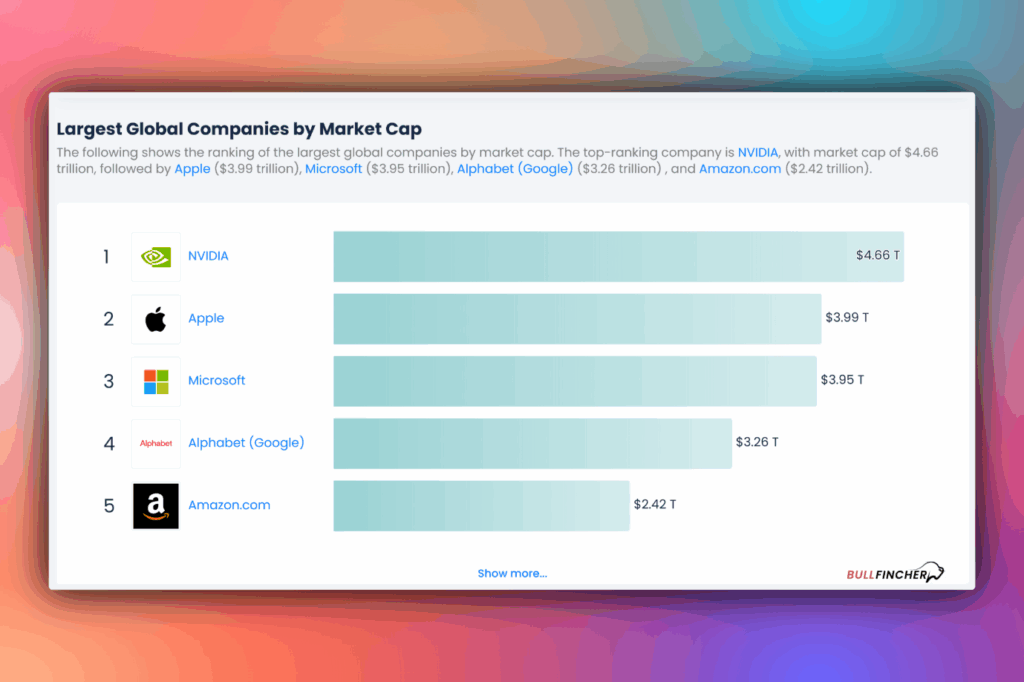
Source: largest companies by market cap | Bullfincher
Apple’s free-float shares account for 99.94% of the company’s shares outstanding. This figure translates to 14.83 billion float shares. Institutional investors are Apple’s largest shareholders. They own 63.86% of the company. In Sep 2025, Apple’s insider ownership was 0.12%. [16]
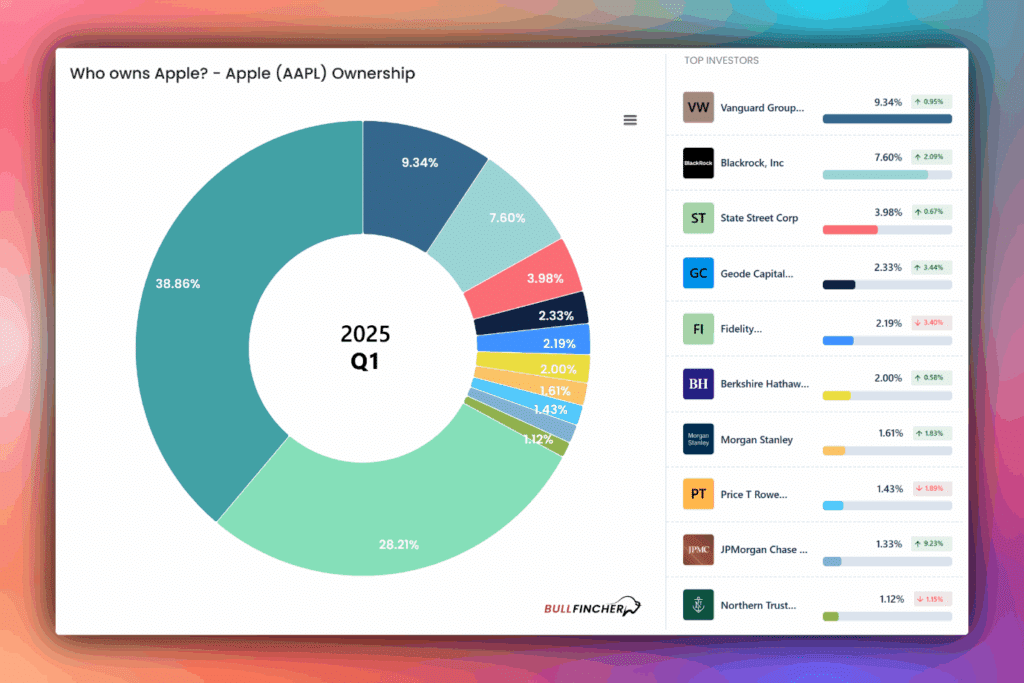
Image Source: Who owns Apple – Apple (AAPL) Ownership | Bullfincher
Apple has over 7,000 institutional owners. These investors own 64.93% of the company’s float shares. As of Jun 2025, Vanguard Total Stock Market Index Fund was Apple’s largest institutional shareholder, with a 3.24% stake. This figure translates to 480.28 million shares worth $114.5 billion. Vanguard 500 is Apple’s second-largest institutional shareholder with 2.86% (423.95 million shares), followed by Fidelity Concord Street Trust at 1.28% (189.25 million), SPDR S&P 500 ETF at 1.22% (181.13 million), iShares Trust at 1.19% (176.81 million), and Vanguard Growth Index Fund at 1% (147.87 million). Other top players include Invesco QQQ Trust at 0.84%, Vanguard Institutional Index Fund at 0.62%, the Vanguard IT at 0.50%, and iShares Russell 1000 at 0.38%. [17]
Apple’s insiders, like the CEO, COO, CFO, and Directors, own shares in the company. Arthur Levinson is Apple’s largest insider shareholder, with 4,125,580 shares. Levinson was appointed Apple’s Chairman in Nov 2011. CEO Tim Cook is Apple’s second-largest insider shareholder with 3,280,300 shares, followed by COO Jeffrey Williams at 390,059, General Counsel Katherine Adams at 179,158, Officer Deirdre O’Brien at 136,687, and Officer Chris Kondo at 15,098. Other insiders owning Apple shares include Director Wanda Austin (1,588), Director Alex Gorsky (5,539), Director Monica Lozano (8,607), and CFO Kevan Parekh (4,569). [18]
Apple returns extra cash to shareholders via buybacks and dividends. It has dominated share repurchases for over a decade. In May 2025, Apple announced plans to return $100 billion to shareholders. The company implemented a share buyback program to boost its stock. However, the 2025 plan didn’t meet Apple’s high bar set in 2024, when it broke corporate records with a $110 billion repurchase strategy. According to CFRA Research, Apple has returned over $945 billion to shareholders since 2012. The company reduced its share repurchase from $110 billion in 2024 to $100 billion in 2025 due to uncertainties over how US tariffs and future growth initiatives could affect free cash flow. [19]
Apple is one of NASDAQ’s most valuable shares. Its stock delivered a 33% return to investors in 2024. The tech giant generated more annual revenue than Microsoft and Google’s parent company, Alphabet, in FY2024. However, Apple posted a 2% year-over-year earnings growth compared to 10.6% for Alphabet and 11.7% for Microsoft. Apple reduced its outstanding shares by 2.2% in 2024 and by 13.8% in the past five years. It pays a quarterly dividend of $0.25 per share, equating to a 0.4% annual yield. The company has raised its yield for 13 consecutive years. [20]
References & more information
- Bullfincher Staff (2025). Apple revenue worldwide 2015-2024. Bullfincher
- Laricchia, F. (2025, Mar 25). Number of Apple stores in European countries 2025. Statista
- Adorno, J. (2024, Dec 30). 6 best new Apple products released in 2024. BGR
- Sherif, A. (2025, Mar 11). Market share of mobile operating systems worldwide from 2009 to 2025 by quarter. Statista
- Reiff, N. (2025, Mar 1). Top Apple Shareholders. Investopedia
- Bullfincher Staff (2025). Apple’s Revenue by Segment. Bullfincher
- Singh, S. (2025, May 13). iPhone Users & Sales Statistics 2025: Worldwide Data. Demand Sage
- Milmo, D. (2025, May 23). Trump threatens a 25% tariff on Apple and Samsung phones not made in the US. The Guardian
- Apple Inc. (2025, Aug 6). Apple increases US commitment to $600 billion and announces American Manufacturing Program. Apple.com
- Levy, S. (2025, Sep 3). Apple Inc.: History of the American company. Britannica
- Shvartsman, D. (2025, Aug 1). Apple Inc.: Facts and Statistics. Investing
- Reed, A. (2024, Aug 20). History of Apple: Company and Stock. NASDAQ
- Howley, D. (2025, Sep 4). Apple’s iPhone 17 is coming, but headwinds abound. Yahoo Finance
- Market Screener (2025, Jun 30). Apple Inc. (AAPL): Stock Quote. MarketScreener.com
- Bullfincher (2025, Oct 4). Apple Inc. (AAPL): Market Cap. Bullfincher
- Bullfincher (2025, Oct 4). Who owns Apple? – Apple (AAPL) Ownership. Bullfincher
- Yahoo Finance (2025, Jun 30). Apple Inc. (AAPL): Top Institutional Holders. Yahoo.com
- Yahoo Finance (2025, Aug 30). Apple Inc. (AAPL): Insider Roster. Yahoo.com
- Kollmeyer, B. (2025, May 2). Apple’s $100 billion buyback disappointed some. Here’s where it ranks historically. Market Watch
- Brantmeyer, C. (2025, Jan 3). Is Apple a Buy, Sell, or Hold in 2025? The Motley Fool
- Featured Image by Laurenz Heymann
- Sphere image by Keming Tan
Tell us what you think? Did you find this article interesting?
Share your thoughts and experiences in the comments section below.







 Ava Abbott


Add comment