
 Kevin Johnson
Google LLC is a global tech company offering online advertising, a search engine, cloud and quantum computing, computer software, e-commerce, consumer electronics, and AI. Its products include Gmail, Google Maps and Earth, Chrome, Google Cloud Platform (GCP), YouTube, Workspace, Android, ChromeOS, Google Drive, Pixel, Nest, Google Assistant, and Gemini. The company also offers language translation, photo storage, videotelephony, wearable technology, machine learning APIs, and AI chips. In May 2024, Google launched Project Astra, an experimental version of a universal assistant. The tech giant updated its Astra in early 2025. Astra’s most impressive new feature is its newfound proactivity. “Astra can choose when to talk based on events it sees,” said Greg Wayne, Research Director at Google DeepMind, “It is kind of the concept car of a universal AI assistant.” [1]
Google is one of the world’s most valuable brands. The company strengthened its market position by expanding its offerings beyond internet services and consumer electronics. Its latest products include quantum computing (Sycamore), self-driving cars (Waymo), smart city solutions (Sidewalk Labs), and AI-powered transformer models (Google DeepMind). As of Nov 2025, Google was ranked fourth on Forbes’ Top 10 companies based on market cap, with $3.37 trillion. It was outperformed by Nvidia ($4.157 trillion), Microsoft ($3.75 trillion), and Apple ($3.409 trillion). [2]
Google’s products and services dominate their respective industries. For example, Google Search is the most-visited website globally, followed by YouTube, Facebook, Instagram, and ChatGPT. YouTube is the world’s leading online video platform. However, the company faces regulatory hurdles. In Aug 2024, a US federal judge ruled that Google illegally holds a monopoly in the search market and dominates online ad technology. The Justice Department proposed that Google should divest its Chrome internet browser unit. Britain’s competition watchdog has criticized Google over its ad tech practices in the UK. “It’s really important we internalize the urgency of this moment and move faster as a company. The stakes are high. These are disruptive moments,” said Google CEO Sundar Pichai. [3]
Google is the world’s largest mapping and navigation app, email, and mobile OS provider based on market share. It is a global leader in the office suite, photo and cloud storage, web browser, machine learning framework, and AI virtual assistant niches. In Sep 2025, a US judge ruled that Google must share search data with competitors. The court rejected prosecutors’ bid to force the company to sell its Chrome browser and Android operating system. This antitrust case has been going on since 2020. But who owns Google? [4]
Who is Google’s Owner?
Google is owned by Alphabet Inc., an American tech conglomerate holding company based in Mountain View, California. Alphabet trades on NASDAQ under the GOOGL and GOOG symbols. In Oct 2015, Google was restructured to create Alphabet Inc. The new entity became the parent holding company of Google and former Google subsidiaries. Alphabet’s operating segments include Google and Other Bets. In 2024, Alphabet generated $350 billion in annual revenue, up from $307.3 billion in 2023. This figure includes $348.1 billion from Google and $1.64 billion from the Other Bets segment. Its profit was $100 billion. The company has over 183,000 employees. [5]
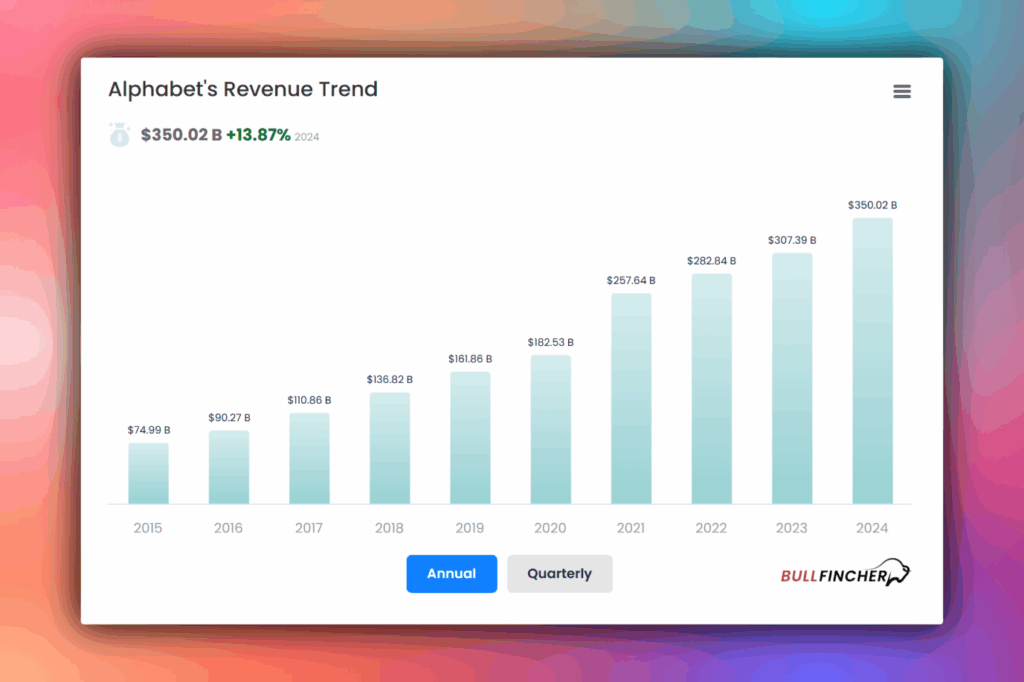
Image Source: Bullfincher.io
Although Alphabet is synonymous with Google Search, its business spans beyond the search sector. The parent company generates around 75% of its earnings from advertising, driven by Google Search. Google Cloud is Alphabet’s fastest-growing segment, providing AI-powered infrastructure and services to businesses. In Q2 2025, Google Cloud generated $13.6 billion, representing 14% of the company’s quarterly revenue. This figure has increased by over 300% in five years. Alphabet is highly profitable. Its net profit margin is significantly higher than the industry average but slightly lower than that of tech giants Microsoft and Meta. [6]
Alphabet is the world’s third-largest tech company by revenue, after Amazon and Apple. Its subsidiaries include Google, Calico, CapitalG, Google Fiber, GV, X Development, Verily, Isomorphic Labs, Waymo, and Wing (drone-based delivery of freight). Alphabet surpassed Apple in Feb 2016, becoming the world’s most valuable publicly traded company. However, Apple resurged to retake the position. Alphabet reached a $1 trillion market valuation in Jan 2020. This milestone catapulted the tech giant into the trillion-dollar club for the first time. In Sep 2025, Alphabet became the fourth company to reach $3 trillion market capitalization. [7]
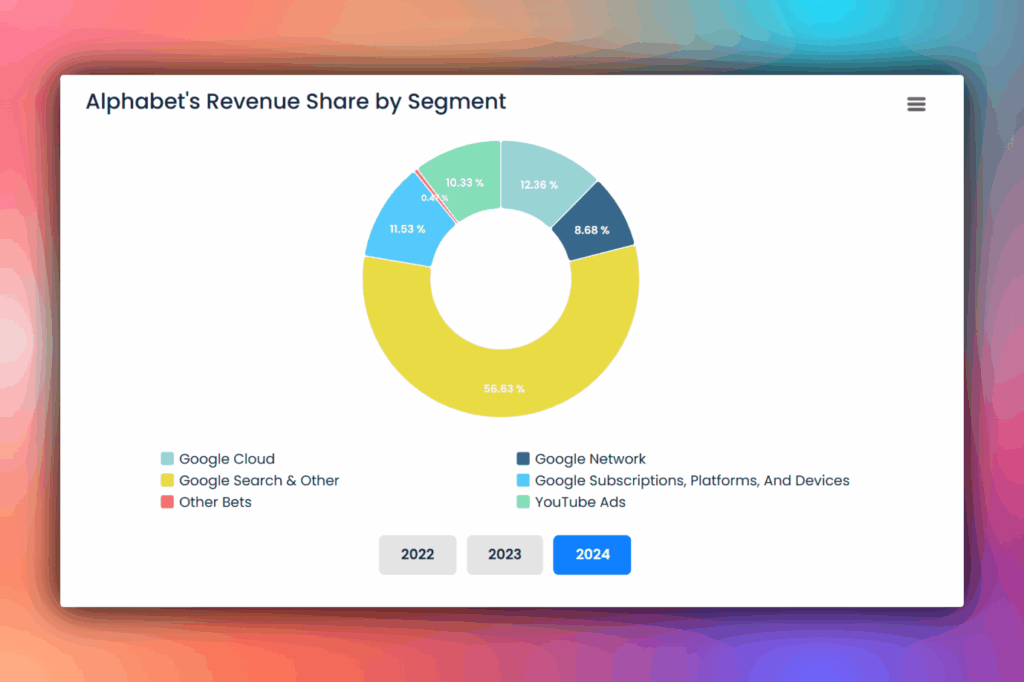
Image Source: Bullfincher.io
Alphabet’s business strategy and decision-making drive Google’s growth. Its top leadership oversees Google’s operations to maximize value for all stakeholders. As of Sep 2025, Sundar Pichai was CEO of Alphabet Inc. He replaced Larry Page as CEO of Google in Oct 2015 and became the CEO of Alphabet in Dec 2019. CEO Pichai’s leadership helped Google and the parent company navigate turmoil, regulatory issues, and geopolitical challenges since 2020. In Sep 2025, Alphabet won Google’s antitrust case. The parent company avoided the breakup of Google’s web browser and mobile OS units, adding $230 billion in value. [8]
Alphabet sells Google’s products worldwide. Its target market spans countries and regions with unique regulations and laws. In 2025, US tariffs threatened Google’s business. Alphabet responded by committing $75 billion in investment in Apr 2025 to strengthen Google’s data center capacity. The company will use the funds to acquire chips and build servers to enhance core offerings, including Google Search and the Gemini model. “We’re all processing what’s happening with tariffs,” said Sachin Gupta, VP and general manager for Google Cloud’s infrastructure unit. [9]
Google’s Ownership History
Larry Page along with Sergey Brin began Google in Jan 1996 as a research project. They were PhD students at Stanford University in California. Page and Brin envisioned the PageRank algorithm. The founders theorized the BackRub system. This system ranked search results by analyzing the relationships among websites, while traditional models counted the page’s search term frequency. Their research project included Scott Hassan, a programmer who implemented Page’s ideas. Although Hassan wrote most of the code for the original Google Search engine, he left the team before Google was founded as a company.
Page and Brin published the Google search engine prototype in 1998 as PageRank. They co-authored the project’s first paper with Rajeev Motwani and Terry Winograd. The pair also partnered with Alan Steremberg, Hector Garcia-Molina, and Jeffrey Ullman to develop the search engine. In Aug 1998, Andy Bechtolsheim, co-founder of Sun Microsystems, invested $100,000 in the project. This investment motivated Page and Brin to incorporate the company. The startup also received funding from Amazon.com founder Jeff Bezos, entrepreneur Ram Shriram, and Granite co-founder David Cheriton. In Sep 1998, Larry Page and Sergey Brin founded Google as an online search firm. They raised $1 million from investors, friends, and family to open a shop in Menlo Park, California. The co-founders hired their fellow PhD student, Craig Silverstein, as the first employee. [10]
Image Credit: Arthur Osipyan
Page and Brin declined Yahoo’s $1 million acquisition offer for their search engine tech in 1998. Google agreed to be acquired by Yahoo for $5 billion in 2002. However, Yahoo missed another opportunity to dominate the search engine market after lowering its offer to $3 billion. Google’s founders relied on investors to fuel their company’s growth. In Jun 1999, Google closed a $25 million funding round fueled by venture capital firms Kleiner Perkins and Sequoia Capital. Both VCs invested $12.5 million each in Google, ensuring Page and Brin retain a controlling majority in the company. In 2000, Google became an advertising-funded search engine and the default search engine provider for Yahoo! [11]
Google experienced internal management wrangles in 2001, led by its top investors. Kleiner Perkins and Sequoia Capital agreed with Page and Brin to hire Eric Schmidt as the Chairman and CEO of Google. CEO Schmidt invested $1 million in Google to show his commitment to the company. This investment gave CEO Schmidt a minority stake in Google. In Aug 2004, Google went public via an IPO and started trading on NASDAQ as GOOGL with 19,605,052 shares. The IPO raised $1.66 billion, increased Google’s investors by over 6,600%, and created 7 billionaires and 900 millionaires from early stockholders. It also extended Google’s ownership to external investors and the general public.
Google’s market capitalization was over $23 billion after the 2004 IPO. The initial public offering made Brin and Page instant billionaires. The company launched Gmail and Google News. Google introduced Google Earth and Google Maps in 2005, redefining navigation with real-time directions for travelers. In 2006, Google expanded its Gmail service to create Google Workspace. This suite includes video conferences, calendars, collaboration and project management software, Google Docs, and Google Drive. In 2008, Google launched its App Engine and expanded into the smartphone market after acquiring Android. The App Engine transformed into Google Cloud, and Android became the world’s most popular smartphone OS. The company unveiled the Google Play Store in 2012 and strengthened its hardware offering with the Google Pixel and the Google Home smart speaker in 2016. [12]
Google leveraged the funds raised from its IPO to fuel its growth. The company expanded through strategic acquisitions, including YouTube for $1.65 billion in Oct 2006 and DoubleClick for $3.1 billion in Mar 2008. By 2011, Google was completing around 3 billion searches daily. It built 11 data centers and thousands of servers worldwide to handle the ever-changing and increasing workload. Google’s monthly unique visitors surpassed one billion for the first time in May 2011.
Google acquired Motorola Mobility for $12.5 billion in 2012, Waze for $966 million in Jun 2013, and DeepMind in 2014. These acquisitions enhanced and expanded Google’s offerings. For example, DeepMind powers Google’s AI and robotics solutions. In Oct 2025, energy startup Commonwealth Fusion Systems (CFS) partnered with Google’s DeepMind division to refine its Sparc reactor using AI. CFS will leverage DeepMind’s Torax software to simulate the plasma inside its reactor and drive AI models to achieve fusion power. [13]
Google became the world’s second most valuable brand, after Apple Inc., for the first time in 2013. It retained this position in 2014, 2015, and 2016 according to Interbrand’s annual Best Global Brands report. In Aug 2015, Google reorganized its portfolio as a conglomerate under Alphabet Inc. The move transferred Google’s ownership to Alphabet. It is Alphabet’s largest subsidiary and Internet service provider. In Nov 2024, Google established a new AI hub in Saudi Arabia to support the Kingdom’s economic growth. The company acquired Wiz for $32 billion in Mar 2025 to strengthen its Google Cloud division. Wiz is a New York-based startup focusing on cloud-based cybersecurity solutions. [14]
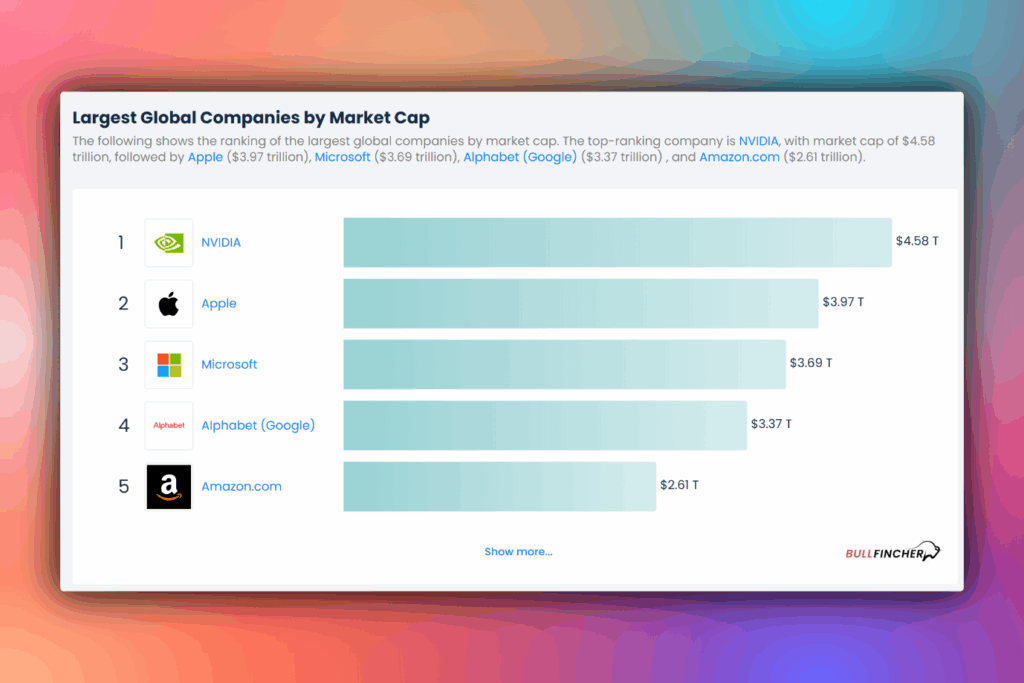
Source: largest companies by market cap | Bullfincher
Google’s Shareholder Structure
Google was reorganized as a wholly owned subsidiary of Alphabet Inc. in 2015. The move separated the core Google business to enhance accountability and autonomy of brands under the company’s umbrella. Google was restructured to focus on Internet services. Its ownership is defined by Alphabet’s shareholder structure. Alphabet Inc. is listed on the large-cap section of the NASDAQ under GOOGL and GOOG. As of Oct 2025, Alphabet had 12.122 million shares outstanding. It has $2.932 trillion market cap and a $245 share price. [15]
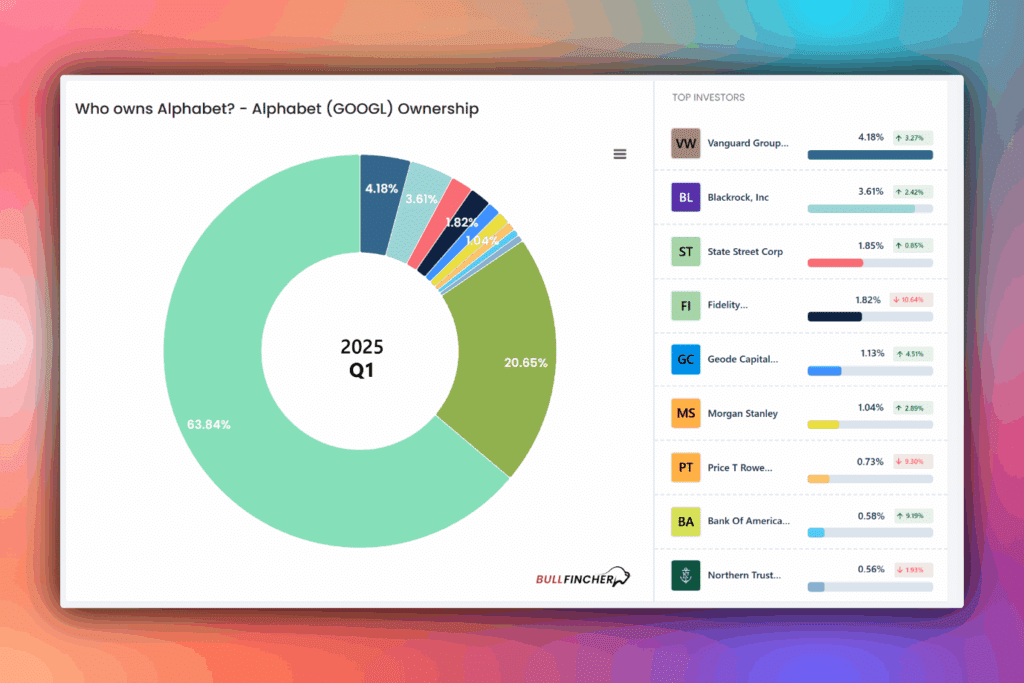
Image Source: Who owns Alphabet – (GOOGL) Ownership | Bullfincher
Alphabet has a distinctive ownership structure with three share classes: A, B, and C. GOOGL shareholders have voting rights, while GOOG shareholders don’t. Class A (GOOGL) shares are traded on the stock exchange and carry one vote per share. This stake is popular among investors. Founders and insiders hold Class B shares, with 10 votes per share. These shares aren’t publicly traded. In Apr 2014, Google created a new class of nonvoting stock and issued a Class C share for each Class A share held by shareholders. The founders leveraged the stock split to capitalize on public-market liquidity while retaining majority control of the company. Class C (GOOG) shares serve as an investment instrument with no voting rights. This tiered shareholder structure concentrates voting power in Class B shares, strengthening the company’s corporate governance. Alphabet announced a 20-for-1 stock split in Feb 2022. [16]
Google’s ownership is spread between institutions, insiders, and the general public. No single person owns 51% of Google’s shares. Although co-founders Page and Brin resigned from their executive roles in 2019, they are still influential in the company. The co-founders collectively command 51% of the voting power through special Class B shares. Page owns 45% of Alphabet’s Class B shares compared to 42% for Brin. In 2025, the Vanguard Group was Alphabet’s largest institutional shareholder. Vanguard controls 7.50% of Alphabet’s Class A shares. BlackRock, Inc. is Alphabet’s second-largest institutional shareholder with 6.31%, followed by State Street Corp at 3.89%, FMR, LLC at 2.81%, and Geode Capital at 2.19%. [17]
Google’s parent company, Alphabet, has 5,447 institutional investors, including index funds and trusts. These institutions hold 60.85% of shares and 65.22% of float. As of Jul 2025, the Vanguard Group owned 2.77% of Alphabet through the Vanguard Index Funds. This stake represents 150.39 million shares. The investment firm also owns Alphabet stock through the Vanguard 500 (2.45%), Vanguard Growth (0.83%), and Vanguard Institutional (0.53%). Other funds and trusts holding Alphabet’s shares include Fidelity Concord Street Trust (1.1%), SPDR S&P 500 ETF (1.06%), iShares Trust (1.02%), INVESCO QQQ Trust (0.84%), Growth Fund of America (0.65%), and American Balanced Fund (0.41%). [18]
Alphabet’s shareholder structure includes insiders, like the CEO, CFO, COO, and Directors. They own 6.69% of the company. In Sep 2025, CEO Sundar Pichai was Alphabet’s largest insider shareholder with 2,429,890 shares. He replaced Larry Page as the CEO of Alphabet Inc. in Dec 2019. President Ruth Porat is Alphabet’s second-largest insider shareholder with 1,979,870 shares, followed by Officer Philipp Schindler at 728,937, Officer John Walker at 84,304, CFO Anat Ashkenazi at 72,410, and Director Robin Washington at 29,495. Other Google insiders holding shares include Frances Arnold, Martin Chaves, John Hennessy, and Amie Toole. [19]
References & more information
- Pierce, D. (2025, May 20). Google’s universal AI assistant prototype can now do stuff for you. The Verge
- Bullfincher (2025, Nov 9). Alphabet (GOOGL): Market Cap.Bullfincher
- Elias, J. (2024, Dec 27). Google CEO Pichai tells employees to gear up for big 2025: “The stakes are high.” CNBC
- Godoy, J. (2025, Sep 2). What comes next in Google’s antitrust case over search? Reuters
- Bianchi, T. (2025, Mar 31). Alphabet: global annual revenue from 2011 to 2024. Statista
- Richter, F. (2025, Aug 21). Alphabet is more than Google Search. Statista
- Elias, J. (2025, Sep 15). Alphabet becomes fourth company to reach $3 trillion. CNBC
- Kharpal, A. (2025, Sep 3). Alphabet adds $230 billion in value after avoiding breakup. CNBC
- Cai, K. (2025, Apr 10). Alphabet reaffirms $75 billion spending plan in 2025 despite tariff turmoil. Reuters
- Hall, M. (2025, Oct. 17). Google: American company. Britannica
- Nucleus_AI (2023, May 9). Yahoo’s Billion-Dollar Blunders with Google, Facebook, Microsoft, and Netflix. Your Story
- Reed, E. (2024, Aug 26). History of Google: Company and Stock. SmartAsset
- Chant, T. (2025, Oct 16). The real reason Google DeepMind is working with a fusion energy startup. TechCrunch
- Preston, D. (2025, Mar 18). Google acquires cybersecurity firm Wiz for $32 billion. The Verge
- CMP Analysis (2025, Oct 21). Alphabet (Google): GOOG. Companies Market Cap
- Kindness, D. (2025, Aug 15). Alphabet’s GOOG vs. GOOGL: What’s the Difference? Investopedia
- Keller, B. (2025, Jan 16). The REAL Power: Who Owns 51% of Google? Surge Graph
- Yahoo Finance (2025, Jul 31). Alphabet Inc. (GOOG): Top Institutional Holders. Yahoo.com
- Yahoo Finance (2025, Sep 15). Alphabet Inc. (GOOG): Insider Roster. Yahoo.com
- Featured Image by Greg Bulla
- Neon Google image by Arthur Osipyan
Tell us what you think? Did you find this article interesting?
Share your thoughts and experiences in the comments section below.








 Ava Abbott

Add comment